Angels Behind the Scenes: Hidden Miracles in Esther
The story of Esther is about the hidden hand of Hashem. But hidden doesn't mean absent. Drawing on Esther Rabbah and other Midrashim, we explore how Divine providence operates through angels, accidents, and unseen nudges.
The Book of Esther is unique in the Bible, and it is one of my favorites.
Most people are aware that the name of Hashem never appears directly in the text, yet it is obvious that He is everywhere in the story, concealed.¹
Esther teaches us that nothing in life is random. That's one reason this book is so deep. It teaches us to look at our own lives from a different perspective; to pay attention to chance encounters and the micro-catalysts that shape our world.
But the Midrashic tradition on Esther continues to draw this out further in creative and even comical ways. Here we learn that G_D does not act alone, and might even deploy a few Angels² to ensure that history unfolds as planned.
Here are a few of these moments from the tradition.
Vashti's Tail?
Angels can be found intervening in the story of Esther earlier than we might expect.
When Achashverosh summoned Vashti, whose name means beautiful, to present herself before his [presumably drunk] guests, she refused. The Talmud offers a few reasons, one of which claims she broke out in leprosy.
Even more interesting, one opinion cites that the Angel Gabriel afflicted her with a temporary tail³. Either way, she refused to come out of her room, and was subsequently removed from the throne.
This created the pretext for Esther's ascension as the Queen of Persia.
In essence, we learn that long before the idea of Haman's decree emerged, G_D had already taken subversive steps to place a Jewish Queen in the palace.
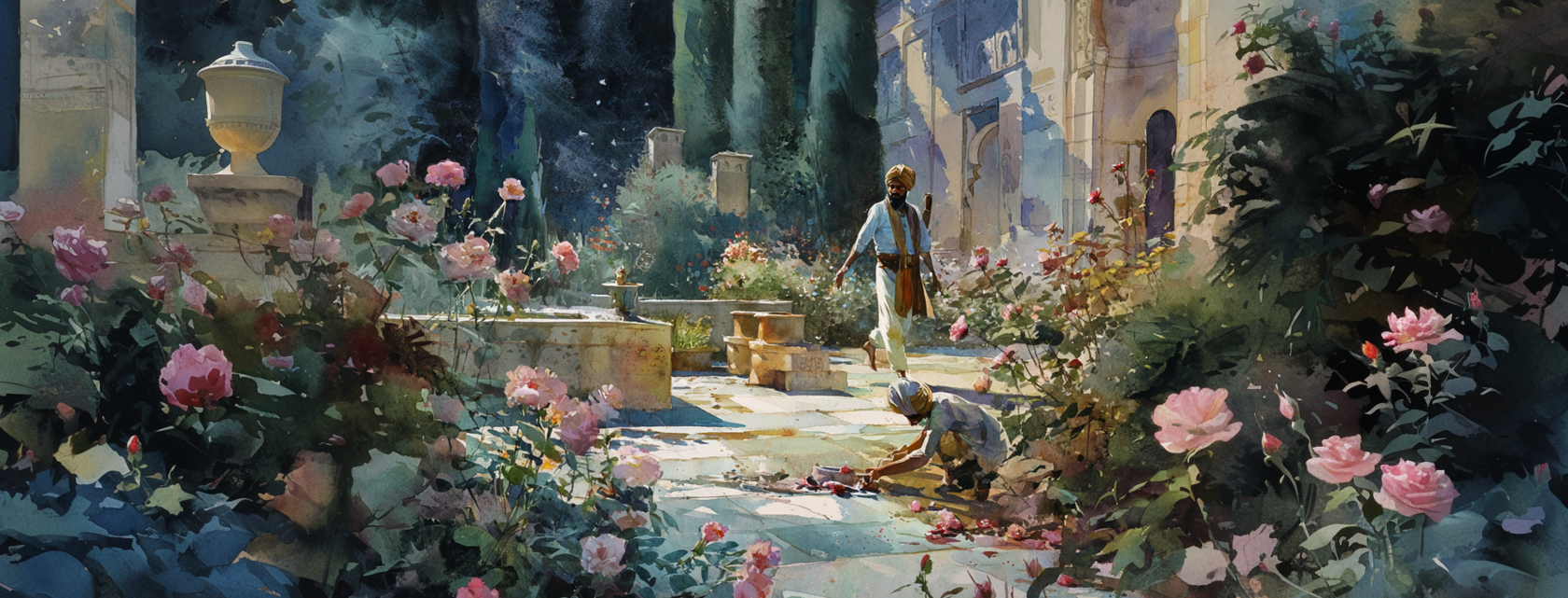
Angels in the Garden, Paradise Lost
Another critical point in the story comes in chapter seven. Esther reveals to King Achashverosh that she and her people are facing annihilation at the hands of Haman.
The King is enraged. To blow off steam, he leaves the scene to stroll through his palace garden.
Persians were renowned for their beautiful gardens. Some suggest that the English word “paradise” comes from the Persian pairi-daēza, meaning “walled garden." Of course, there seems to be a deeper connection with the Hebrew word, Pardes, here - but that is for another time.
Nevertheless, the beauty of the King's garden does not seem to calm him down.
The Midrash says that while walking through his garden, the King came across evidence that the palace gardeners had destroyed some of his favorite plants. We're told that this wayward gardener was the Angel, Michael⁴.
Needless to say, this angered the King. As the highest-ranking member in his court, Rabbi David Fohrman suggests, this was believed to have been the work of Haman.
This stroke is subtle and genius, and Michael scores a direct hit. The King is now in the perfect degree of rage for what follows.

Haman's Literal Fall
While Achashverosh was in the garden, Haman desperately pleaded for his life from Esther. In a moment of panic, he leaned forward, falling onto the couch where Esther was reclining.
Imagine this: the King, angry about Haman's devious plan and now his ruined garden, returns to find Haman lying on Esther! He says:
"Does he even dare to assault the queen in my presence, in my own house?" - Esther 7:8
Haman was likely confused as to how he got into that position, but the Midrash tells us that Michael pushed him and held him there until the King's return.
Haman's fate was sealed.
The Oddly Specific Bystander
Things spiral quickly. Accused and dishonored, Haman's arrest is underway when a servant casually offers a helpful suggestion:
Then said Charvonah, one of the chamberlains that were before the king: ‘Behold also, the gallows fifty cubits high, which Haman hath made for Mordecai, who spoke good for the king, standeth in the house of Haman.’ And the king said: ‘Hang him thereon.’ - Esther 7:9
Where did this guy come from? This chamberlain, whose name is Charvona, gives oddly specific details. Not only does he call attention to the gallows in Haman's residence, but he also reminds the King of Mordechai, who saved his life earlier in the story.
This one always makes me laugh as it is easy to imagine the look on Haman's face at this moment. The Midrash tells us that the chamberlain is none other than Elijah the Prophet.
"What did Elijah, his memory be a blessing, do? He assumed the guise of Charvonah, one of the chamberlains of the King." - Pirke DeRabbi Eliezer 50:10
Again, names are important. The Hebrew name Charvonah is related to the word (חרבן) Churban, meaning destruction. Elijah shows up at just the right moment to ensure Haman's destruction.
Hidden Miracles
For me, it's not about historical accuracy. The Midrash is teaching us a deep and comforting idea that, behind the chaos of life, things are always moving according to plan.
We're reminded that G_D does not always operate through open miracles like the splitting of seas or miraculous plagues; thus, it is easy to assume that nothing is happening. We forget that He also works through calculated subtlety.
Whether an overzealous gardener or a momentary loss of balance, what looks like an accident is orchestrated with precision, and it is happening everywhere, all the time, at a scale we cannot begin to imagine.
This happens beneath our perception, moving the world towards redemption, one step at a time.
Notes:
¹ Esther, and the Art of Concealment
² Angels & Intermediaries: The Role of Malachim in Creation
³ Tractate Megillah 12b
⁴ "He [Michael] began cutting the saplings before the King, adding fury to his fury." - Esther Rabbah 10:9