
Hastening Messiah | A Conversation with Efraim Palvanov
Efraim Palvanov is an author, teacher, and speaker who blends deep Jewish tradition with his background in science. He is savvy, with degrees in biology and education, and even served in the Canadian Armed Forces.

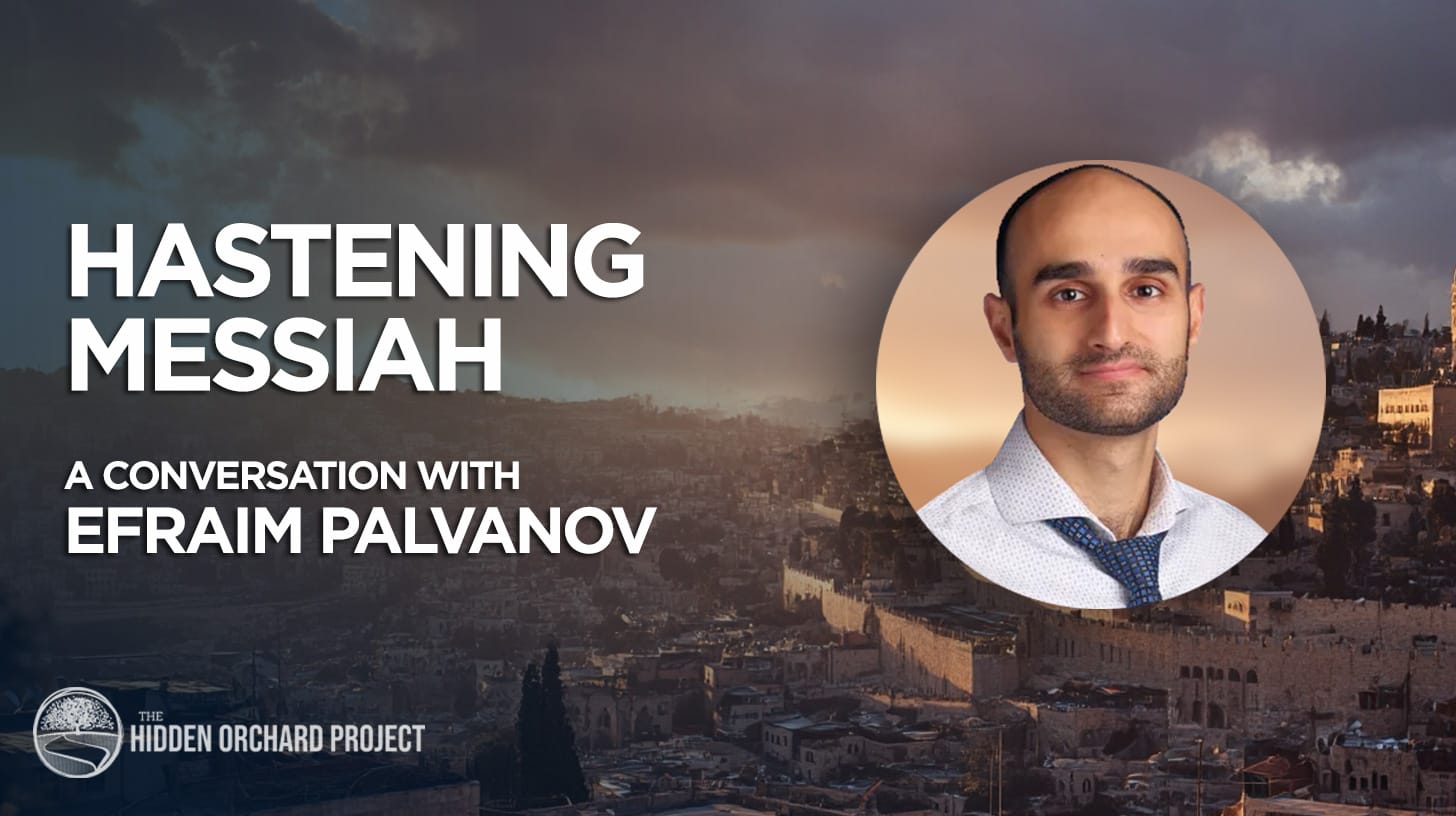
It is always exciting when I get to share resources that have been meaningful to me. The guest featured in this segment is a teacher I've benefited from over the last few years, and whose content I have shared often. Efraim Palvanov.
Efraim is an author, teacher, and speaker who blends deep Jewish tradition with his background in science. He is savvy, with degrees in biology and education, and even served in the Canadian Armed Forces.
Efraim is a treasure; his insights and range of knowledge are impressive. And he uses these gifts to boldly tackle topics not often discussed in Torah circles, such as; The Big Bang theory, the Erev Rav, the Noahide Laws, Gilgul, and more.
Underlying his content, I sense a subtle urgency that complements the times in which we live, urging people to seek Hashem and align their lives with the wisdom of the Torah.
A future goal would be to spend some time digging deeper into these topics in an interview, but, for what time permits us, consider this an introduction.
Q: What’s the biggest misunderstanding about what the Messiah is actually supposed to accomplish?
Efraim:
The main role of Mashiach ("the Messiah") is to bring peace to Israel, reunite all the Jewish people, and re-establish the Davidic dynasty (see Ezekiel 37).
Furthermore, Mashiach is supposed to oversee the construction of the Third Temple in Jerusalem, which will be an international house of prayer for all of mankind (see Isaiah 56:7).
There is no need for the Messiah to be a "miracle child" or work any miracles at all. He is a wise, righteous, and charismatic leader who can educate and inspire the world to recognize the one true God, and to live a more meaningful, moral, and Godly life.
Q: Can the Messianic Age be triggered by human action, like repentance or good deeds, or is it in Hashem's timing?
Efraim:
There is a final deadline for the start of the Messianic Age, which is the year 6000 on the Jewish calendar (we are about to start the new year 5786 later this month).
However, through our actions and good deeds, we can hasten the Messianic Age and cause it to come sooner. This is partly based on Isaiah 60:22, which says that God will "hasten" the Final Redemption "in its time." In other words, there is a set time, but we are able to hasten it.
Q: What are the ways we might delay Messiah's arrival?
Efraim:
Although our Sages do suggest that there are certain immoral practices that "delay the coming of Mashiach", at this point in history when we are already so near to the end, there isn't really much space to cause further delays!
Global events are showing us how rapidly things are moving towards the Final Redemption. Prophecies are being fulfilled daily right before our eyes.
Q: What will change in the Messianic era? And is it sudden, or protracted?
Efraim:
Change definitely takes time. Jewish tradition holds that Mashiach will be king for forty years (like King David and King Solomon), and then his son will be king, and his grandson afterwards.
During this time the world will transition to a new era of peace and prosperity for all. We will ultimately return to a Garden of Eden-like state. Among other things, Isaiah prophesied that people will live long and healthy lives, with "the youngest dying at one hundred years old" (Isaiah 65:20) and that "nations shall beat their swords into plowshares... and never again know war." (Isaiah 2:4)
Q: When this happens, what changes in the Torah? Does the Messiah bring freedom from Torah, or more obedience to it?
Efraim:
The Torah is eternal and will not fundamentally change. The Torah is precisely what brings a person to a life of true freedom!
In fact, our Sages pointed out that in Hebrew, the word used for "engraving" the Ten Commandments on the Tablets (harut) is nearly identical to the word for "liberty" (herut). In effect, God was emphasizing that true freedom comes from observing His commandments.
Q: What will the role of non-Jews look like in the Messianic Age?
Efraim:
All of mankind will recognize the one true God (Zechariah 14:9) and live joyfully in an era of global unity and peace, morality, spirituality, and abundance.
Q: What can Gentiles do to hasten the geulah?
Efraim:
Observe the Noahide Laws! Teach others about God, the Torah, and Israel. Help to combat the rampant antisemitism, Judeophobia, and Israel-hatred that is sadly sweeping the world, exacerbated by misinformation on the internet and social media.
Q: Can Gentiles take on Torah commandments, specifically, those for Jews, as a means of hastening Messiah? (Assuming they are already observing the Noahide laws)
Efraim:
The great Rambam (Rabbi Moshe ben Maimon, 1138-1204, "Maimonides"), in codifying Jewish law, states that Noahides are able to take on additional Torah mitzvot voluntarily if they so choose. It certainly has value, for otherwise it would never have been codified as law!
That said, I don't think the goal in doing so should be hastening the coming of Mashiach. Rather, it should be a personal choice based on a deep desire to grow closer to Hashem and fulfill His law.
Q: Where can people find your latest work?
Efraim:
My website is Mayim Achronim - www.MayimAchronim.com and the YouTube channel www.youtube.com/EfraimPalvanov.
You can also find books on Amazon.com.
Want To Learn More?
 The Hidden Orchard
 The Hidden Orchard
 The Hidden Orchard
🌱 Enjoying what you’re discovering? 🌱
Support The Hidden Orchard and help us grow and share with others.