
Was Thomas a Doubter? The Pharisees' Tradition and the Resurrection.
Thomas's refusal to believe in the resurrection without seeing Jesus's wounds is typically read as a failure of faith. But against the backdrop of rabbinic tradition, the Gospel of John affirms details of the Pharisaic tradition of the Resurrection of the Dead.
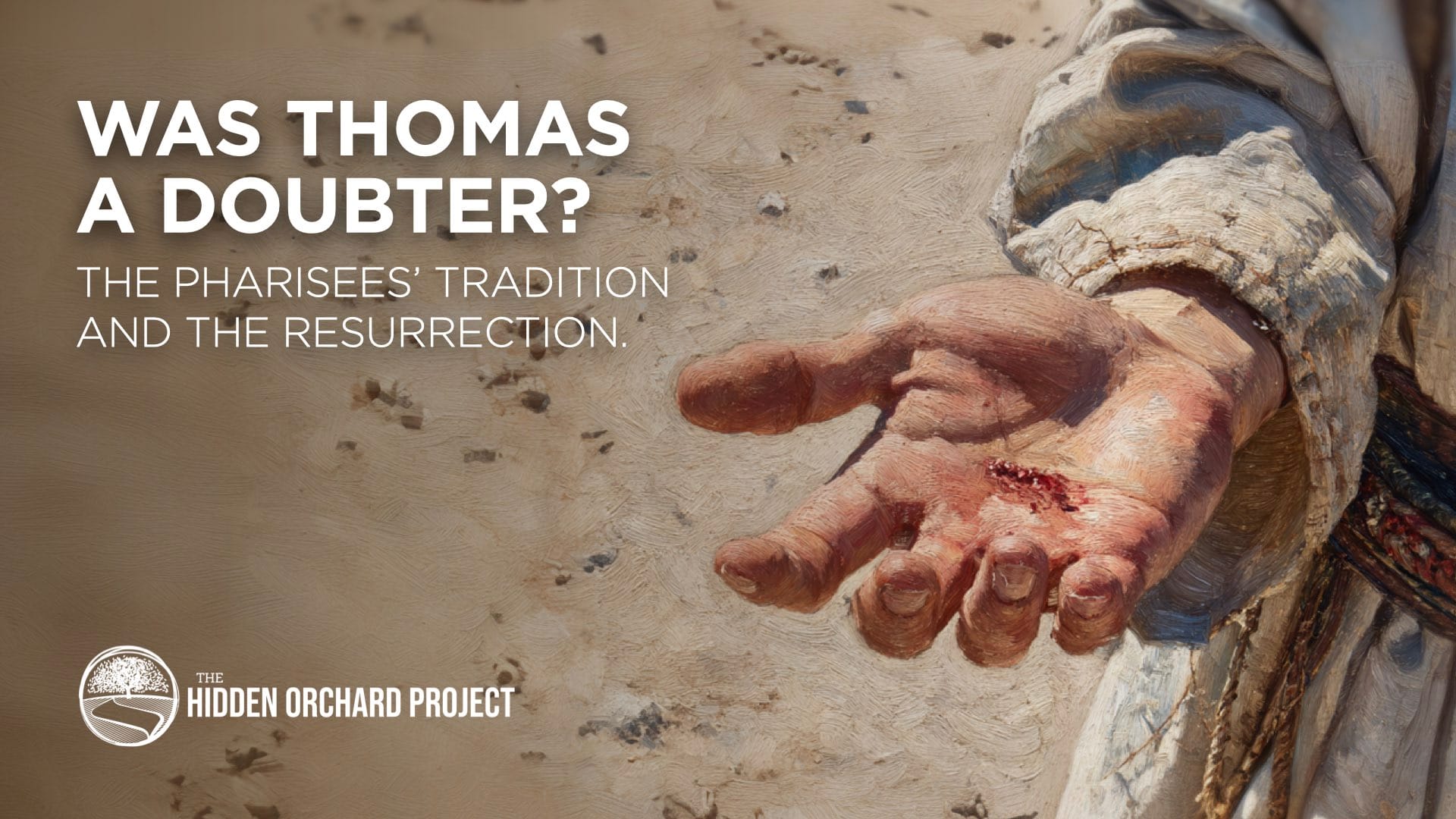
In the Gospel accounts, Jesus was crucified and later resurrected, appearing to some of his students. His disciple Thomas was not there at that moment, and when the others told him what they had seen, he refused to believe it. But there is more to his refusal.
From this episode, Thomas would become known, for centuries, by the nickname of "Doubting Thomas."
But in Thomas's words, there is an unusual condition of belief that warrants further exploration.
"Now Thomas, one of the Twelve, called the Twin, was not with them when Jesus came. So, the other disciples told him, We have seen the LORD. But he said to them, "Unless I see in his hands the mark of the nails and place my finger into the mark of the nails, and place my hand into his side, I will never believe."" - John 20:24-25
Why would anyone expect to see wounds on a resurrected person?
Interestingly, his words reflect a deeply Jewish belief about the resurrection. In addition, this passage might set the stage for a somewhat Midrashic overlay to this entire encounter, a common technique in the Gospel of John.
The Rabbis and The Resurrection of the Dead
"Tekiyat HaMetim," is the Hebrew term translated as the Resurrection of the Dead. While many may associate this idea with Christianity, it is actually something brought to us from the Rabbinic tradition.
And while this idea is widely believed to be part of the final transition into the World to Come¹, the specifics are not found in the Hebrew Bible.
Through the methodology of Pardes², the Rabbis mined, at best, hints of how things may play out in the lead-up to the World to Come. The Resurrection of the dead came up quite a bit.
One question that occupied Rabbinic discussion was what a resurrected body might look like. It is a logical question. Do bodies emerge decayed, or completely ethereal? Cleopatra once asked Rabbi Meir if the resurrected would be naked or clothed³. Again, logical.
Prophetic Contradictions?
In one discussion, Reish Lakish raised a contradiction between two prophetic texts. Isaiah 35:6 promises that "the lame shall leap like a deer and the tongue of the mute shall sing," hinting that the resurrection will be free of disability and suffering.
However, Jeremiah 31:8 speaks of the ingathering of the "blind and the lame," suggesting that the resurrected may still have their previous physical conditions.
Who is right?
In Tevye form, Reish Lakish offers that both Prophets are right!
How so? When resurrected, the dead will arise still afflicted with their defects, and they will then be healed.
- Sanhedrin 91b
At first, the resurrected will arise with their defects and ailments. But later, they will be restored.
Midrashic Musings
While there is a strong belief that people will be restored to an earlier age of life, the immediate age of return is the same as at the moment one passed away⁴.
In the Midrash, we read:
“Let them arise the same way in which they expired, and after their awakening, I shall heal them.”
- Genesis Rabbah 95
The Zohar states:
“In the time when Israel will be resurrected from the earth, there will be many blind and mute people and other defects, but then G_D will illuminate them with the great intensity of the sun and heal them.”
- Zohar 1:203b
According to Rabbinic tradition, wounds come back with us, but once we reach a certain degree of transition to the World to Come, the final healing occurs.
Thomas May Have Been Onto Something
The question is, what is the reason for this two-step process?
On one hand, we're told it helps with identification. If you come back fully healed, perfectly restored, how would anyone know it is you? We might not recognize a twenty-year old version of our great-grandparents.
But there is another reason.
Thomas Was Not Doubting.
Remember, Thomas said: "Unless I see the wounds, I will never believe." Thomas understood the tradition, and he knew what to expect.
We're told that the reason for this process is precisely to provide evidence to anyone who might have doubts about the Resurrection. There is a concern that doubters may not believe the Resurrected are the same people who went into the grave, but some kind of new creation.
The Midrash says;
“Why is it that a person returns just as he departed? It is so [people] do not say; ‘When they were alive [G_D] did not heal them; ... It seems that these are not the same person, but different people.’
The Holy One blessed be He says: ‘If so, let the resurrected stand as they departed, and then I will heal them.’ - Genesis Rabbah 95
To me, beliefs around the Resurrection are structured to address an anticipated and widespread disbelief.
The point of the Gospel story was not to expose Thomas's personal flaws, but to impart a broader theological message.
Reframing the Resurrection
This brings us to one final point in this story.
If you were a Jew in the first century, belief in the Resurrection of the Dead was not universal. It was a belief championed by the Pharisees⁵, and seems to have been shared by a few other groups.
Still, the Talmud records many discussions in which some, such as the Sadducees, rejected it outright, arguing that it lacked a clear grounding in the Torah. Even in the Apostolic community, views on the resurrection were mixed.
Where much of Christianity has viewed the resurrection as a closeout of the Torah's commandments and the Jewish tradition, the Apostles saw it very differently.
For the disciples, Jesus's resurrection confirmed that the Sages were right, even including the Rabbinic ideas of a two-step process.
The resurrection also raised the ethical expectations. If indeed G_D will bring forth a resurrection, then how we live in the present actually matters, and this requires a response today.
Instead of abandoning the Torah and tradition, the Apostles saw them as a critical roadmap that leads to the resurrection. Sanctification.
Through this view, obedience to the Torah is participation in redemption itself and functions as our daily preparation for the World to Come.
Want to Learn More?
 The Hidden Orchard
 The Hidden Orchard
 The Hidden Orchard
Notes
¹ What Comes After Heaven? A Guide to the World of Souls and the Olam HaBa
² PaRDeS - Jewish Hermeneutics
³ Talmud Sanhedrin 90
⁴ Genesis Rabbah 95
⁵ Video: Misreading the Rabbis. Recovering the Context of the New Testament | Part 1