

Developing Our Emunah in the Field
The Hebrew word for faith is Emunah, but it is more than religious optimism. Emunah helps us understand trials and challenged, and even the paradox that trials may be the best way to develop this skill.

When things go wrong in life, we are told to have faith. But faith, as many use the word today, can seem more like religious optimism. This falls short of its true meaning.
The Hebrew word Emunah (אֱמוּנָה), usually translated as “faith,” means something deeper.
Hebrew Root Word
To understand, it helps to know that most Hebrew words are derived from a three- or four-letter root word, known as a shoresh (שֹׁרֶשׁ).
Words that share a root form a family and are thematically linked.
For example, the root word for Emunah is formed from א-מ-ן (aleph-mem-nun), which gives us a few words Amen; Uman, a craftsman; and Omen, a guardian.
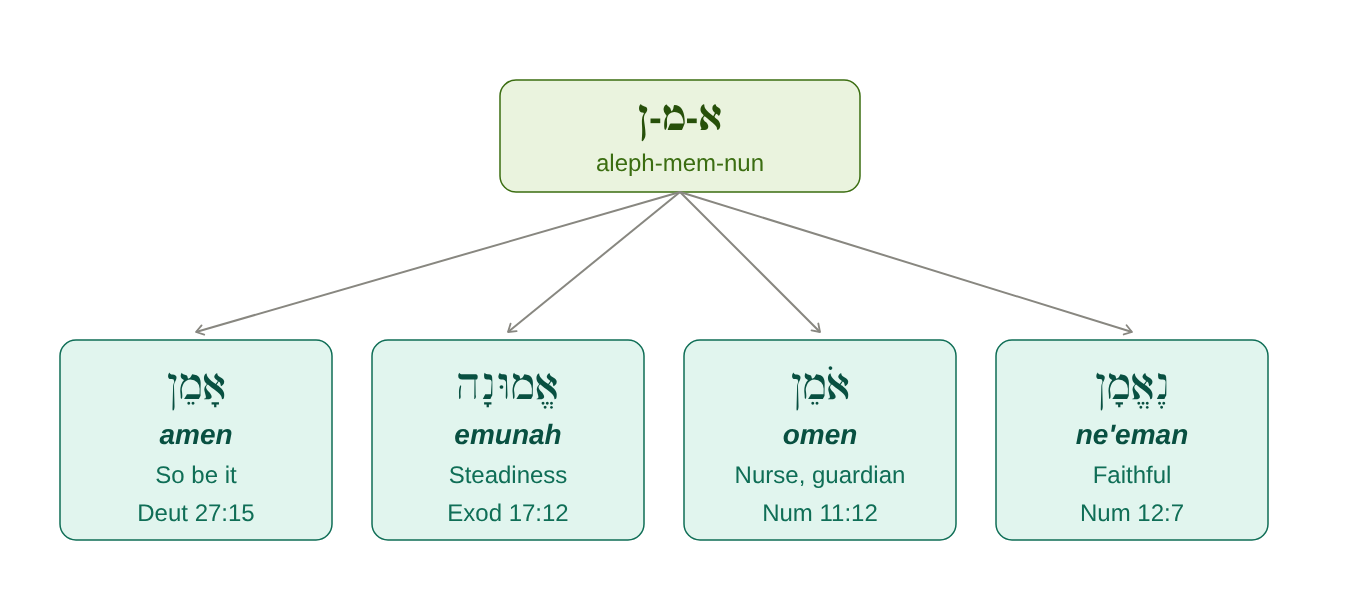
Through this word family, Emunah has an active quality, one that takes practice to develop, and diligence to guard.
Moses Hands Were Steady
The first appearance of the word is found in Exodus 17:12. The battle at Rephidim raged on, and Moses's hands were raised to support his troops:
"But Moses’ hands grew heavy; so they took a stone and put it under him, and he sat on it, while Aaron and Hur, one on each side, supported his hands; thus his hands remained steady (אֱמוּנָה) until the sun set."
With the support of Aaron and Hur, Moses's hands were now Emunah, steady.
We can see how the modern concept of faith does not quite work here. Emunah is, therefore, not simply a feeling or belief, but a steady state of being.
One of my favorite stories¹ illustrates this idea.
Gamzu L'Tovah
Rabbi Akiva was born in the middle of the first century and lived through some of ancient Israel's the most challenging times².
For over twenty-two years, he studied under a teacher named Nachum Ish Gamzu³, a man known for his Emunah. Nachum is best known for his famous saying, "Gamzu l'tovah", which means "This too is for the good."
Once on a long journey, the sun was setting, and Rabbi Akiva stopped in a village and asked for lodging. No one would take him in. Recalling his teacher's lesson, he said to himself:
"Everything the Merciful One does, He does for good."
With nowhere to go, he had little choice but to sleep in a nearby field. He made a makeshift camp with his three belongings: a rooster, a donkey, and a lamp.
It was a rough night. The whipping wind kept blowing out his flame. A wild cat snatched his rooster, and a lion attacked and killed his donkey. Left with nothing, he repeated: "Everything the Merciful One does, He does for good."
In the early hours of the morning, he awoke to the sound of soldiers entering the village on horseback. From his vantage point in the field, he witnessed the havoc as they took the town captive.
Had the lamp been lit, the rooster crowed, or the donkey brayed, he too would have been found and taken captive. Rabbi Akiva said, 'Did I not say, Everything the Holy One, blessed be He, does is for good?'
He had a deep understanding that everything G_D orchestrated had been for the good, even when the opposite seemed true.
Emunah is Not Denial
I often think of this story when life seems to take a turn in the wrong direction. I whisper to myself, "Gamzu l'tovah." It is my way of suspending judgment, waiting to see the big picture emerge.
The difference is this: Emunah is not believing that things will eventually net out in the positive despite the bad stuff. It is trusting that they are going exactly as they need to.
At times, we are blessed to see the full picture and how an event was for the good. But sometimes, we don't.
In the Field
One last thought. In Jewish tradition, the field is a metaphor all its own. It can represent everyday life, and the challenges we face.
In the house, we're protected under a roof, but in the field, we're vulnerable. Sometimes the field is the best place for us to remember this truth. It was the field that Isaac went out to pray⁴, and in the month of Elul, the King meets us in the field, on our terms⁵.
The field is the proving ground we call, life.
As in the story above, sometimes we do not choose the field; instead, we are routed there by circumstances. But in that place, we are given the best opportunities to develop our Emunah into something firm and enduring.
Notes:
¹ Talmud Berakhot 60b
² From Ruin to Resilience - Jewish Revival Post-Temple Destruction
³ Chagigah 12
⁴ Genesis 24:63