
Peter's Vision: Is Acts 10 About Dietary Law?
Peter’s vision in Acts 10 is often interpreted as evidence of the nullification of the Torah’s dietary laws. Yet a closer reading reveals a different story. Further, this episode reads like a Midrash on Gentile inclusion, shaped by Biblical imagery and a distinctly Rabbinic style of storytelling.

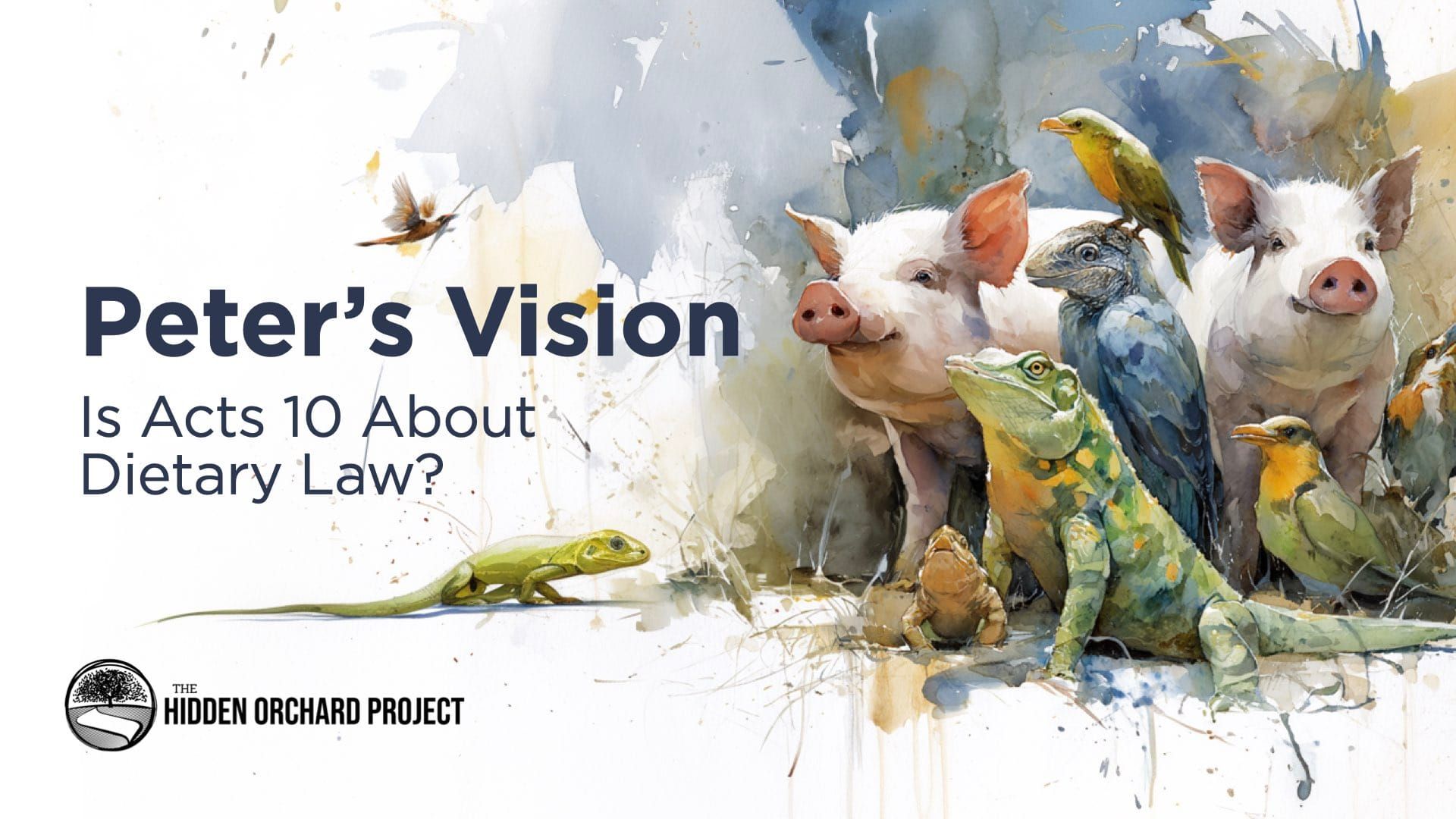
In popular readings, Peter’s vision in Acts 10 serves as a go-to text that the Biblical dietary laws, known as kashrut, were rendered obsolete. When stacked with other passages, such as Mark 7, where Jesus declared all foods clean¹, the case seems to be closed.
Yet when we read this story carefully, and through a Jewish lens, the popular interpretation has some problems.
Aside from Peter's own reaction, this story also uses some familiar Midrashic elements that are worth exploring. It seems the author wanted to communicate something greater than dietary liberty.
Let's look deeper.

Peter's Vision
In Acts 10, we find Peter praying on a rooftop in Yafo, a beautiful and ancient city on the Mediterranean coast of Israel. The text mentions that he is hungry when he receives this vision:
He saw heaven opened and an object, something like a large sheet, descending, being let down to earth by its four corners. In it were all kinds of four-footed animals and reptiles of the earth and wild birds.
- Acts 10:11-12
A Divine voice, a Bat Kol, commands, “Rise, Peter; kill and eat.” But he refuses, affirming his ongoing obedience to the Torah's dietary laws.
If the Apostolic writers intended to abrogate the Biblical dietary laws, known as Kashrut, this was their big moment.
But they don't. And Peter does not pause to ask whether the law has changed. Instead of seeking out his first unclean food experience, the Apostle senses a deeper meaning and meditates on the hidden message.
“Peter was inwardly perplexed as to what the vision might mean.” - Acts 10:17
There is important symbolism here that many readers miss.
The Symbolism of the Number Four
The first thing we notice is that the number four is mentioned several times. Four often represents the four corners of the Earth, a euphemism for the world, and sometimes, the Gentile Nations.
This is why certain prayers and rituals, such as the shaking of the Lulav during Sukkot, are said while pivoting and facing the four cardinal directions: North, East, West, and South.
The four corners of the Earth are associated with the Messianic era from which the exiles will be gathered:
“He will assemble the scattered of Judah from the four corners of the earth.” - Numbers Rabbah 23:14
Animals, a Symbol for People?
A prominent feature in Acts 10 is the use of unclean animals. A Jewish audience would recognize this literary tool, where animals symbolize people or entire nations in the Bible.
In Genesis 16:12, Ishmael is described as a wild donkey, and other passages compare the tribes of Jacob to various animals, too.
Sheep are often a symbol for Israel, a metaphor Jesus himself used in the Parable of the Sheep and the Goats. Sheep are docile and listed among the clean animals in the Torah. By contrast, Goats, due to their association with sin offerings, often represent the wicked.
The Psalms liken hostile nations to dangerous or predatory animals, such as lions or wild dogs. Jesus reflects this tradition in his conversation with the Canaanite woman².
In Daniel 7, the Prophet describes four 'beasts' rising from the sea. Rabbinic tradition interprets these beasts as Gentile empires, accordingly:
- The lion represents Babylon
- The bear represents Media-Persia
- The leopard represents Greece
- The terrifying, unnamed beast represents Rome
These four animals are dangerous predators of sheep (i.e., Israel).
“The nations of the world are likened to beasts of prey, while Israel is likened to a sheep among seventy wolves.” - Genesis Rabbah 76
Within this range of symbolism, describing the Gentile nations as unclean animals connects the original audience with Biblical and Rabbinic metaphors.
Thus, a Jewish audience would not have derived a conclusion of dismissing the Torah commandments in Peter's vision. Jesus himself warned against this kind of thinking.⁴
But there are even more striking parallels to explore.
Kosher Pigs?
Talmud Sanhedrin 59b shares a story:
Rabbi Chalafta was walking along the road when he came across hungry young lions. Immediately, two thighs of meat descended from Heaven. One appeased the lions, the other was taken to the study hall for discussion.
The Rabbi asks:
"Is this thigh a kosher item or a non-kosher item?" The Sages said to him: "Certainly it is kosher, as a non-kosher item does not descend from heaven."
Another Rabbi asked,
"What if a donkey had descended for him? Would it have been permitted?"
It is a good question; donkeys are not Kosher. Rabbi Abbahu replied:
"... The Sages already said to him that a non-kosher item does not descend from heaven."
The Talmud and Acts 10 share a similar theme. The Rabbis muse that forbidden and unclean things will be permitted in the Messianic era. Some even suggest that even the pig will be Kosher!
"He [G_D] permits what is forbidden. What is meant by permitting what is forbidden? Some say that all the animals that became impure in this world, G_D will purify them in the future." - Midrash Psalms 146:7⁵
The Meaning of Peter's Vision
The text tells us that Peter meditated on his vision for a while. Upon meeting Cornelius, the message became clear:
“G_D has shown me that I should not call any person common or unclean.” - Acts 10:28
Peter continues:
“I truly understand that G_D shows no partiality, but in every nation anyone who fears Him and does what is right is acceptable to Him.” - Acts 10:34–35
In the mid to late first century, the Jewish world was under the guidance of the Pharisaic School of Shammai⁶. Somewhere in this time, they enacted 18 edicts - protective measures - on the Jewish people that discouraged interactions with pagans. These spiritual protections are a large part of the conflict between the Apostles and the Judeans in their time. This is the source for Peter's statement in 10:28.
To his surprise, Peter learned that not all Gentiles are spiritually unclean pagans. Something had shifted. Cornelius foreshadowed the Gentile prototype associated with the Messianic era.
With this background, we can see that unclean animals in Acts 1o are symbolic. This story reads like a Rabbinic-styled Midrash about a spiritual reality where Gentiles seek a connection with the G_D of Israel.
In fact, beyond the metaphor, this passage has little to do with the dietary laws at all.
Learn More About This Passage
Notes:
¹ Traditions and Commandments: Understanding Jesus's Teaching in Mark 7
² Unexpected Encounters: Jesus and the Canaanite Woman
³ “The swine, when it lies down, stretches out its hooves as if to say: ‘See, I am clean.’ So too does the wicked kingdom of Edom [Rome] boast as though it were righteous.” - Leviticus Rabbah 13:5
⁵ Citation in Commentary on the New Testament. Strack and Billerbeck. pg 808