

Rereading Romans 13: Did Paul Say to Obey the Government?
Paul's famous "submit to governing authorities" may not have been about Rome. Reading Romans 13 in its synagogue setting reveals a different take on who the "rulers" were, and what Paul may have meant.


Romans 13:1-7 is often read as Paul's instruction to Christians to submit to their civil government. Applied throughout time, this means Caesar, the Reich, or whatever regime happens to hold power.
Though Jewish tradition encourages people to pray for the welfare of the government¹, it also teaches to be wary of the ruling powers.
Paul's call for blanket obedience also seems to go against the narrative of the New Testament. Why would Paul advise unconditional authority to the Roman Empire who crucified Jesus, and would soon execute both Paul and Peter?
Looking closer, this may not have been his intended message.
Common Assumptions
The popular interpretation is based on three assumptions:
- Paul's audience was a Christian community,
- the setting was the "church", and
- the "rulers" were the local government.
But what if all three of these traditional assumptions are faulty? Let's reexamine and see if a new understanding emerges.
1. Paul's Audience in Rome
In a previous article², we've explored how the communities Paul wrote to were not homogeneous "churches" in the modern sense.
Instead, these were a mix of Jews and Gentiles, some of whom were followers of the Jesus movement, and some who were not. Throughout Paul's letters, he preserves this nuance, for example:
Brothers, sons of Abraham, and those among you who fear G_D, to us has been sent the message of this salvation - Acts 13:26
In this context, "Brothers" are Jews; "Sons of Abraham" is a common Jewish euphemism referring to converts, and "Those who fear G_D" are the Gentiles who are now participating in the synagogue communities.
2. The Setting
Scholars generally agree that churches, as we think of them - Gentile congregations who follow Jesus - did not exist in Paul's generation.
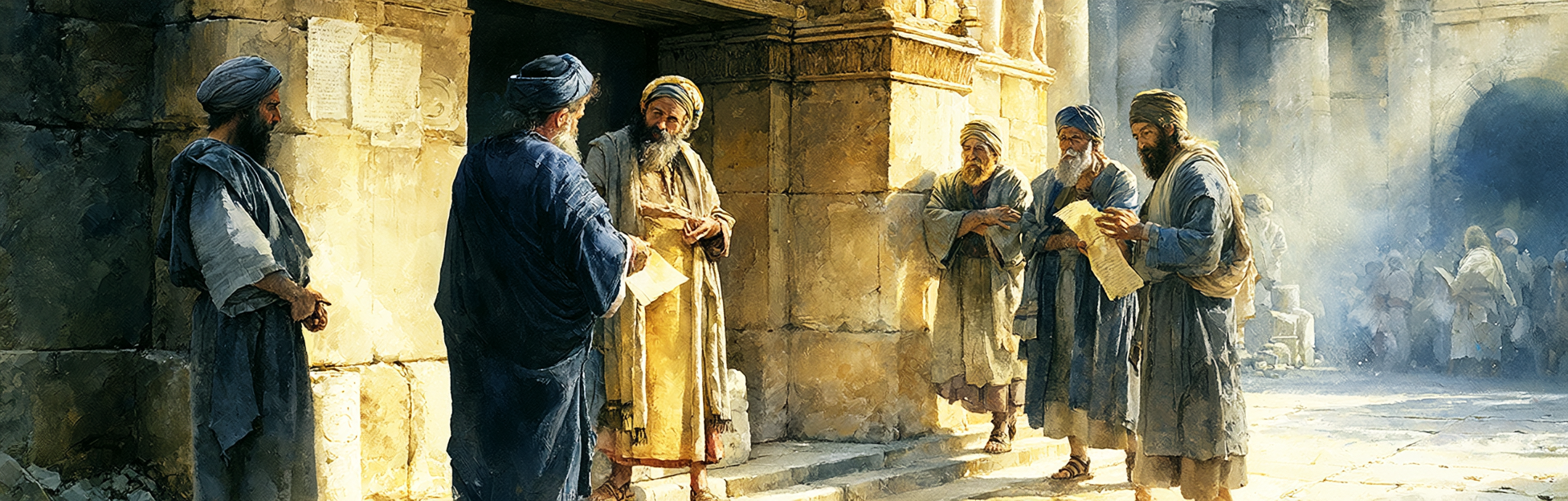
The New Testament itself tells us several times that the setting was the Synagogue⁴.
In his work, "The Mystery of Romans,³" Jewish New Testament scholar Mark Nanos strengthens the case that the incoming Gentiles were participating within the existing Jewish communities in Rome.
With a more nuanced perspective on the audience and the setting as a synagogue, we can better understand who Paul's "rulers" may have been.
3. The Rulers
In Romans 13:1-6, several terms are used to describe the leadership structure the letter's recipients must obey.
Mark Nanos thoroughly unpacks these terms in succession⁵:
- Archon (ruler)
- Exousia (authority)
- Diakonos theou (servant of G_D)
- Leitourgos (minister)
Despite the popular interpretation that assumes Hellenistic-style imperial officeholders, Nanos suggests these terms were also used for synagogue authorities in the Jewish diaspora.
These would be the various leadership and administrative roles found in the synagogue community.
Further, the word for "rulers" (ἄρχων) in Romans 13 is elsewhere used to describe the ruler of a synagogue in the Gospels:
"Just then there came a man named Jairus. This man was a ruler (archōn, ἄρχων) of the synagogue..."
- Luke 8:41
The parallel story in Mark 5:22 uses archi-synagōgos, the synagogue ruler, more specifically.
Bearing The Sword
Another verse that leads many to assume Roman rulers is verse 4:
"...he is G_D's servant for your good. But if you do wrong, be afraid, for he does not bear the sword in vain. For he is the servant of G_D, an avenger who carries out G_D’s wrath on the wrongdoer." - Romans 13:4
Nanos argues that "bearing the sword" refers to the local Jewish court. This is the Beit Din (בֵּית דִּין) who holds the authority to govern their congregation.
For me, this mention of the sword falls in thematic line with other metaphorical sword passages, such as the sword as the Word (Hebrews 4:12), the sword of the Spirit (Ephesians 6:17), and the Prophet's mouth, like a sharpened sword, to bring judgment (Isaiah 49:2).
This makes more sense to me. I imagine Paul's audience would have had a difficult time, in the plain sense, envisioning Emperors like Caligula, Nero, and Domitian as G_D's ministers and servants, carrying out justice on the wrongdoers.
Taxes
Lastly, verse 7 instructs the giving of taxes:
"... for this reason you also pay taxes, for the authorities are G_D's servants devoted to governing."
While this may seem like a direct reference to Roman taxation, Nanos and others associate this with the Temple tax sent from the Diaspora communities to the community in Jerusalem.
Paul mentions this several times in his letters⁶, that the Gentiles should help add to the financial gifts and support of the leaders in Jerusalem. For Paul, this would go a long way to show their transformation.
Other communities seemed to have no problem with it, however, the Roman Gentiles needed some convincing:
But now I go to Jerusalem to minister to the saints. For Macedonia and Achaia are pleased to make some contribution for the poor among the saints in Jerusalem. For they are pleased to do this, and indeed, they are indebted to the Jerusalem saints. For if the Gentiles have shared in their spiritual things, they are obligated also to minister to them in material things. - Romans 15:25-28
On this, Nanos writes:
"... the function of the "servants of G_D" within the Jewish community was to devote themselves to the collection and safe delivery of the Temple tax to Jerusalem."
This seems to have been a source of contention among the Romans:
"Tacitus refers derisively to the Gentiles ("people of the worst sort") who "renouncing their ancestral religions" would send their tributes and gifts to Jerusalem in heaps."⁸
The Seat of Moses
Synagogue leaders are the center of Jewish community life. They hold delegated Divine authority to lead, teach, judge, administer, discipline, guide in spiritual matters, and much more.
Tradition maintains that this authority can be traced back to Sinai. And this is why Jesus himself instructed his students to obey the Rabbis who "sat on the seat of Moses."⁹
Paul seems to be reaffirming that instruction.
Missing Context
While Paul's advice might seem obvious, to some, given our exploration, there is some missing history that might explain why he took the time to write this down.
In the years before Paul's letter (circa 41 CE), Emperor Claudius took the throne of the Roman Empire. Around 49 CE, he expelled the Jewish people from Rome for "disturbances."
Though there is some debate on the scale and cause, some scholars attribute this to the influence of the Jesus movement, as it caused many Gentiles to abandon allegiance to the Emperor.
As the movement, at this time, was indiscernible from the normative Jewish community, the Jewish people as a whole suffered expulsion.
Apparently, for these years, the Roman congregations operated without their Jewish members, developing their own customs, ideas, and assumptions. When Claudius died in 54 CE, Jews returned to a community that looked and functioned very differently.
It seems some of the Gentile leaders may have had a difficult time relinquishing their positions of leadership. Paul's letter seems to address the roots of an early form of Replacement theology.
This might explain the emphasis on passages about Jewish preeminence (i.e., Romans 1:16) and the enduring importance of Jewish identity (Romans 9 through 11).
It seems Romans 13 follows this flow, instructing the Gentiles to obey the synagogue leaders who have been given their authority from G_D.
Conclusion
The result of this excursus is actually surprising, and it goes against 1,800 years of Church history and tradition.
Paul seems to have instructed the Gentile participants in the Roman Jewish communities to obey the authority of the synagogue leadership.
What we have is another powerful verse that ascribes authority to the Rabbis and the Jewish framework in general.

Want to Learn More?
 James - The Hidden Orchard
 James - The Hidden Orchard
 James - The Hidden Orchard
Notes:
¹ Pirke Avot 3:2; 1:10
² Paul's Audience(s) in the New Testament
³ The Mystery of Romans. Mark Nanos
⁴ Moses Is Preached In Every City: The Missing Key to The Jerusalem Decree
⁵ Mystery of Romans, Chapter 6
⁶ See: 1 Corinthians 16:1–4; 2 Corinthians 8–9; Galatians 2:10; Romans 15:25-28
⁷ The Mystery of Romans. Page 308-309
⁸ The Mystery of Romans. Page 309