

Moses Is Preached In Every City: The Missing Key to The Jerusalem Decree
The outcome of the Jerusalem Council wasn't simply a welcome letter to the Gentiles; it was a framework for ongoing growth. And without the venue, the synagogue, the letter's guidance falls apart.

The outcome of the Jerusalem Council wasn't simply a welcome letter to the Gentiles; it was a framework for ongoing growth. And the most foundational aspect of this system, the synagogue, is often left out of the equation.
A Quick Recap
We've made the case that the four requirements of Acts 15 may have been an extension of the seven Noahide laws¹. This gave the incoming Gentiles a starting point for participation in the Jewish community short of full conversion.
The Jerusalem decree reads:
"... we should not trouble those of the Gentiles who turn to G_D, but should write to them to abstain from the things polluted by idols, and from sexual immorality, and from what has been strangled, and from blood."
What James, Jesus's brother, says next is one of the most important parts of the letter:
For from ancient times, Moses has had in every city those who proclaim him, for he is read every Sabbath in the synagogues.” - Acts 15:19-21
This is not a casual observation. It was written with the assumption that readers would be familiar with what a synagogue was and how it functioned.
Arguably, the venue is as important as the letter itself, a package deal.
Born in Exile
Synagogue is actually a loanword from the Greek, but the Hebrew term, beit knesset (בֵּית כְּנֶסֶת), means house of assembly.
Many scholars believe synagogues emerged sometime early in the Babylonian exile, after the destruction of the first Temple. Jewish life had been built around Jerusalem: the altar, the offerings, and the priesthood, but without these, what did it mean to be the people of G_D?
Israel faced an existential crisis.
An Enduring Solution
The synagogue was the solution. Sometimes referred to as a mikdash me'at, a little temple, the synagogue is not a replacement for the Temple.
No matter where Israel found itself, if ten Jewish men could be found, a minyan, a synagogue could be established.
What is interesting is that the synagogue did not cease to exist when the nation returned from exile. By the first century, it had become the backbone of Jewish life, both in Israel and abroad.
What Happens In the Synagogue
Those unfamiliar tend to envision a synagogue as a Jewish church, a place you go once a week for religious services. It's much more.
How to establish and manage a synagogue is not spelled out in the Torah. Rather, this wisdom is sourced from within the Jewish tradition. This institution, and even its physical characteristics, were borrowed by the church, yet most Christians have never visited a synagogue.
The synagogue was simultaneously a house of study, a courthouse, a community center, a treasury, and sometimes a place for travelers to stay.
Since the time of Ezra, the Torah was also read publicly on Mondays and Thursdays², the traditional market days, when people from surrounding villages came into town. In this way, the Torah would be heard by as many people as possible.
Legal disputes and rulings were also adjudicated there, as well as community announcements, and even disciplinary action. This adds insight to Jesus's statement about the Rabbis who sit on the "seat of Moses."³
Also, when Paul wrote about a flogging he received, it likely took place in the local synagogue.
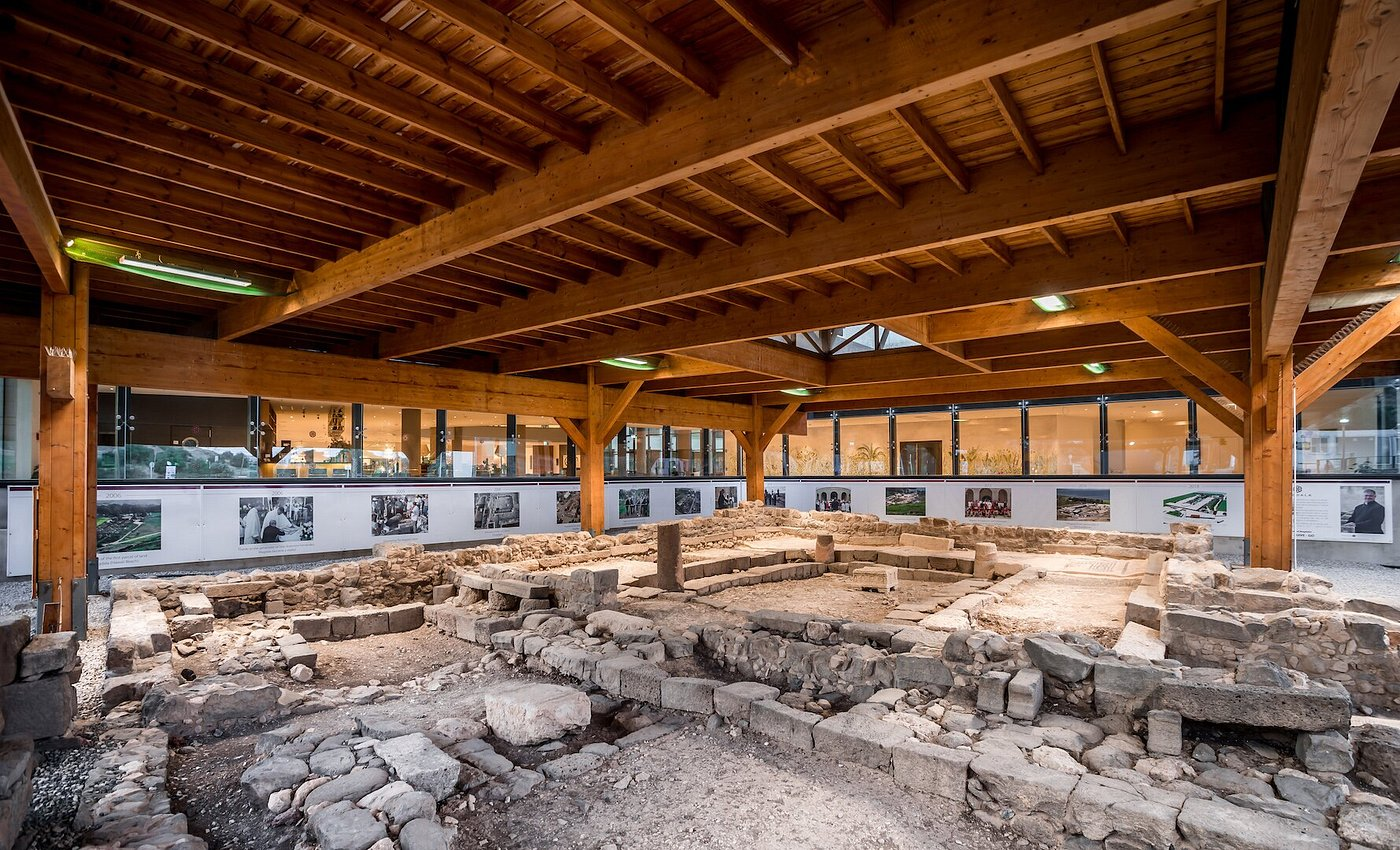
The Building
If a community could afford it, they may have been able to build its own structure. Otherwise, it was not uncommon to build a synagogue between a few villages that jointly funded the building.
The physical space reflected a few traits that are still consistent to this day. No matter where in the world you are, the building layout is oriented towards Jerusalem.
Not always, but benches often lined the walls, and a raised platform known as the bima⁴ was located at the center or front. It is from the bima that the Torah scroll would be read aloud.
Most synagogues maintained an ark (an ornate cabinet) or at least a designated room to protect the Torah scrolls.
Because Jewish law prohibits destroying any writing that contains the name of G_D, worn or damaged scrolls couldn't simply be discarded. Since ancient times, they have been retired to a genizah⁵, a storage space for sacred texts awaiting a formal burial. Some incredible finds have come from excavations of ancient caches like this.
Liturgy: The Rhythm of the Community
Though bustling throughout the week, the primary gathering was the weekly Shabbat. In ancient times, much of the community gathered for prayers and a lecture on Friday evening.
The main service seems to have been on Saturday afternoon, which included a public reading of the Torah portion, the Parashah, and a reading from the Prophets, known as the Haftarah. Jesus himself attended and took part in these services, as the Gospels record.
In first-century Israel, these were likely read in Hebrew. However, because Hebrew had waned in use for most diaspora Jews, the text was accompanied by an Aramaic translation known as the Targum.
Often, the reader would deliver a drash, an interpretive teaching, that connects the preceding readings. These practices are still upheld today.
The Sidra
Here is the surprising fact for some: in the Second Temple period, the primary focus of the sermon was not theological or homiletical. The focus was halachic, a study of Jewish law. This lecture was known as the Sidra.
Rabbi Adin Steinsaltz⁶, writes:
"The main subject of the Sidra was a halachic matter which the Rabbi would explain in great detail... The halachic themes of the sidra were of various kinds, chosen by the scholar."
These legal topics would be focused on the issues that a particular community had a pressing need to learn. This is especially true in the case of an approaching holiday:
"... about a month before each of the pilgrim festivals, and the high holy days, they made it a point to begin teaching about them, and explaining their themes and special laws."
Halacha, properly understood, is how the people remained set-apart, even when living among various pagan cultures. This was where the community learned to walk in the ways of G_D, and had a chance to learn about the finer points of a commandment.
The Missing Key to Acts 15
Now return to Acts 15. The Jerusalem Council decided that Gentiles entering the community do not need to take on the full burden of Torah observance to begin their journey.
But - and this is important - it was assumed that they would be present in the synagogue each Shabbat to hear Moses preached. "Moses" is a code word for the Torah, and as we're learning, it refers to the Torah's commandments.
James and the leaders believed their ruling would be enough to get started, but the real learning and development would continue over time, in the synagogue.
An Unfortunate Reality
I believe the Apostles never imagined their movement leaving this venue. James wasn't writing to a church. When he addressed his communities, he spoke about the synagogue (συναγωγὴν).⁷
There was no alternative venue where Gentiles would gradually learn the Torah, the calendar, the traditions, the interpretations, and observe the holidays. And to be honest, there still is no alternative.
The synagogue has been the backbone of Jewish life for thousands of years - surviving exile, occupation, and the destruction of the Temple itself. It was, and is, the one institution everyone could take for granted⁸.
When the movement drifted outside the synagogue, the early communities lost the context and the setting for which the decree was written.

Notes:
¹ The Roots of Gentile Inclusion: Noahide Laws and the Jerusalem Council
² Talmud, Bava Kamma 82
⁵ Genizah
⁶ The Essential Talmud Rabbi Adin Steinsaltz. Pg. 25
⁷ James 2:2-5
⁸ The Essential Talmud Rabbi Adin Steinsaltz. Pg. 104.
"As the synagogues had existed for so long and the format of prayer was well established, no basic changes took place in the prayer procedure after the destruction of the Temple,..."