
The Accidental Apostle: The Story of Pseudo-Dionysius
What if one of the most influential thinkers in church history turned out to be a case of mistaken identity? We'll look at how an anonymous Neoplatonic writer slipped into the stream of Apostolic tradition and shaped the Church's understanding of heaven, hell, angels, and salvation.

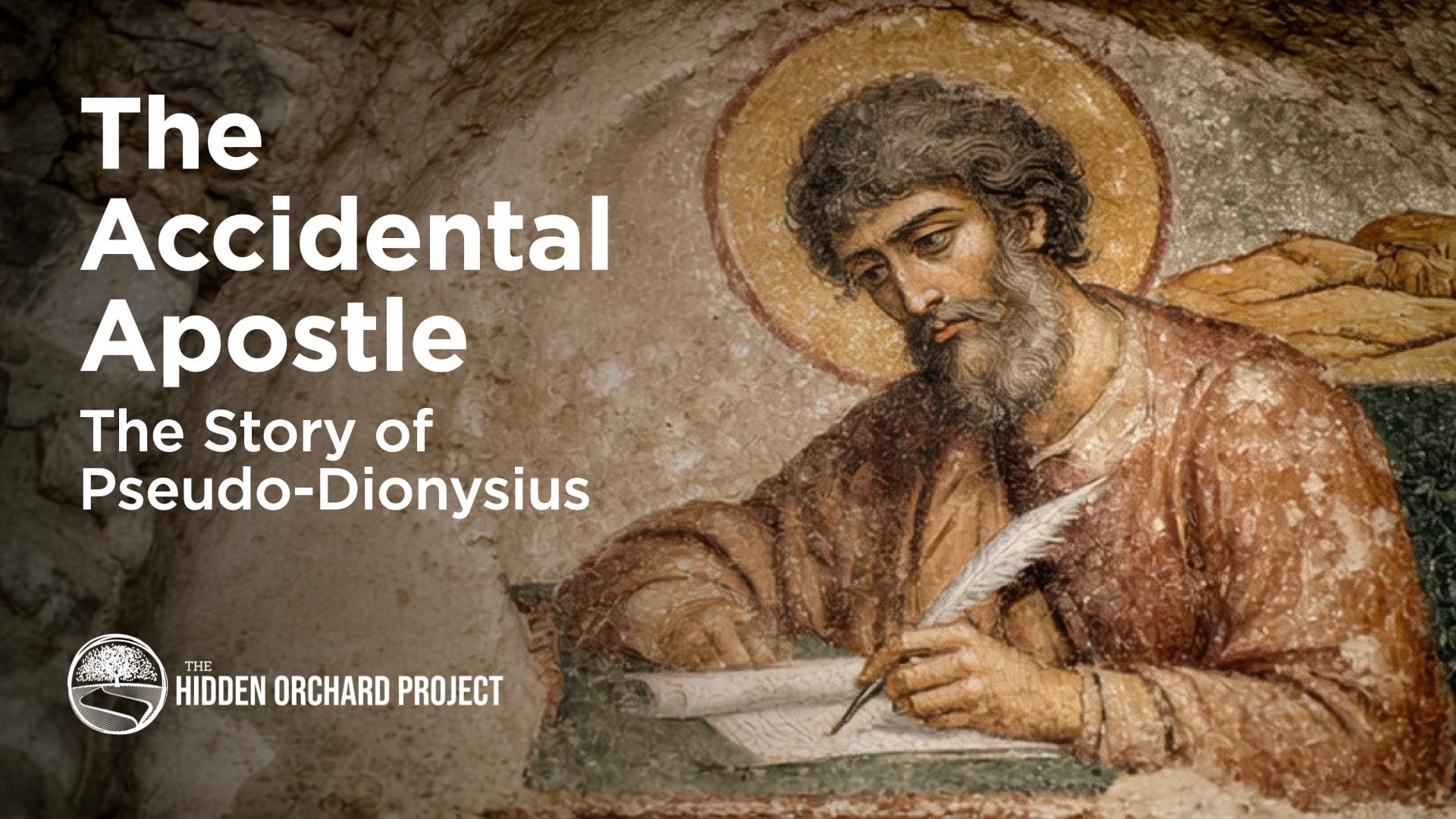
What if one of the most influential thinkers in church history turned out to be a case of mistaken identity?
That’s exactly what I stumbled into while researching a related subject.
In this article, we'll look at the comical, semi-frustrating, and astonishing history of how an anonymous Neoplatonic writer slipped into the stream of Apostolic tradition, misdirecting the Church's understanding of heaven, hell, the nature of creation, and salvation.
The consequences cut deeper than many realize.
Pseudo-Dionysius
Scholars know this inadvertent theologian as Pseudo-Dionysius¹, an anonymous Christian thinker from the 5th or 6th century.
Writing under the pen name Dionysius the Areopagite, many Church fathers seem to have mistaken him for the Athenian philosopher who became a student of Paul in Acts 17:
Some of the people became followers of Paul and believed. Among them was Dionysius, a member of the Areopagus... - Acts 17:34
Writing under a pen name was not rare in that time, but the influence this author achieved seems unprecedented. This case of mistaken identity persisted for over 1,000 years!
The Encyclopedia of Philosophy states;
"Presenting himself as Dionysius the Areopagite, the disciple of Paul mentioned in Acts 17:34, his writings had the status of apostolic authority until the 19th century when studies had shown the writings denoted a marked influence from the Athenian Neoplatonic school of Proclus..."
During his time, Pseudo-Dionysius wrote a set of works² that infused Christian theology with Neoplatonism, especially the thoughts of Proclus of Athens³.
The philosophy of Proclus is problematic because it was pagan. Proclus was not a Christian. Yet, Pseudo-Dionysius borrowed his cosmic structure and other ideas, importing them with Apostolic authority.
Wild, right?
These writings contributed to the early rise of dualism in the Church, which remains a significant theological point of divergence from the Jewish worldview from which the New Testament emerged.
Tracing Platonic Influences
Now, to be fair, Pseudo-Dionysius did not solely introduce dualism into Christianity. But his writings surely helped to normalize this influence for a millennium.
In a recent article⁴, scholar N.T. Wright shared his view that Platonism has caused Western Christians to misunderstand core Biblical ideas for hundreds of years. I agree.
We'll explore where these ideas live on today, but the roots of Platonism were planted very early on in the early church through thinkers like:
- Philo of Alexandria (20BC-40CE)
- Origen (185-253CE)
- Gregory of Nyssa (331-395CE)
- Augustine (354-430CE)
- and many others
By the 9th century, Pseudo-Dionysius's works were translated into Latin, solidifying their study in the West. From then on, they were elevated, believing they were from a direct disciple of Paul.
Interestingly, early theologians preferred the teachings of Paul's Greek convert, and not the teachings from his Jewish teacher. Perhaps, by that time, these ideas resonated more with the growing church as it had departed its Jewish roots.
Thomas Aquinas and Dante Alighieri
Thomas Aquinas⁵ was fond of Pseudo-Dionysius's writings, quoting him over 1,700 times in his own works. His framework influenced Aquinas towards the ideas of a tiered universe, an angelology built on the work "The Celestial Hierarchy," shaped by Neoplatonism rather than Jewish cosmology⁶.
Dante⁷ seems to have adopted the structure of the universe found in Pseudo-Dionysius. This informed his ideas of heaven, angels, and his vision of Hell, as famously depicted in Dante's Inferno⁸. From here, the idea of eternal punishment⁹ shifted toward the popular interpretation many assume today.
These ideas are woven into Christian theology so thoroughly that they are difficult to detect.
Influences + Time = Deviation
This puts many things into perspective for me. In many conversations, I’ve noticed that while many people are unfamiliar with the classical Jewish Biblical traditions behind the Apostolic writings, they carry some assumptions. The question is: where, and from whom, did those assumptions derive?
Some other ways Platonism has impacted the church can be seen through ideas, such as;
- Viewing salvation as an escape from the world, expressed through statements like "this world is not our home..."
- A distinct separation between spiritual and physical
- The rejection of the Torah's commandments through a devaluation of the physical
- Holiness is only associated with spiritual, not physical
- A general spiritualization of concepts, unplugging them from their physical aspects
The goal here is to look at where things went wrong and to help find the path back.
The Takeaway
Where Platonism separates the physical and spiritual, the Biblical worldview seeks a holistic alignment between them.
Where Platonism sees physical creation as generally negative, the Biblical view teaches that bodies are vessels that, when kept pure according to the Torah's wisdom, enable harmony and Divine Presence to dwell in the world.
Lastly, the final redemption is not an escape from the material world but its restoration and (re)infusion with the spiritual.
This is why the work of Tikkun Olam is as important as ever, and it is accomplished when we begin to recognize the spiritual within the physical¹⁰.
Notes:
¹ Pseudo-Dionysius the Areopagite (fl. 500 C.E.)
² Writings: The Divine Names, The Celestial Hierarchy, The Ecclesiastical Hierarchy, and Mystical Theology.
³ Proclus of Athens - Proclus Lycaeus 412–485 CE
⁴ NT Wright: Western Christians have misread Heaven, the End Times, spiritual warfare
⁶ The Living Heavens: Angels, Stars, and Biblical Cosmology
⁸ Inferno, The Divine Comedy. Dante Alighieri
⁹ Eternal Punishment: Understanding “Hell” Through Rabbinic Thought