

The Hardening of Pharoah's Heart and the Egyptian Heart-Weighing Ceremony
Ancient Egyptians believed the soul was judged by the weight of the heart, and the Torah uses similar language for Pharaoh. Coincidence? Did God harden Pharaoh's heart, or, as Rabbi Jonathan Sacks suggests, is there another story in the text that modern readers have missed?


I first heard this idea mentioned by the late Rabbi Jonathan Sacks, z''l, in a teaching on Parasha Vaera¹. He noticed a fascinating connection behind some confusing passages in the Exodus story: the hardening of Pharaoh's heart.
Pharaoh's Hardened Heart
In the story of the Exodus, the text tells us that Pharaoh's heart was hardened many times. The Hebrew uses different phrases for this idea;
- strengthened (חזק Chazak)
- made stubborn (קשה Kasha)
- made heavy (כבד Kaved)
This idea is troubling for some. Someone once told me the idea that G_D would override someone's free will was a deal-breaker for them.
I can see their point. In many of those instances, it does seem that G_D Himself hardens Pharaoh's heart.
The logical question, then, is how Pharaoh can be punished for refusing to let the Israelites go if his refusal was manipulated?
As Rabbi Sacks pointed out, the answer may reflect ancient Egyptian religious beliefs, something the original audience would have recognized immediately.
Let's explore this.
Maaty - The Hall of Two Truths
In Ancient Egypt, it was believed that death was the beginning of the soul's judgment in the afterlife.
The deceased's soul would journey to the underworld, Duat, where it would enter Maaty, the "Hall of Two Truths."
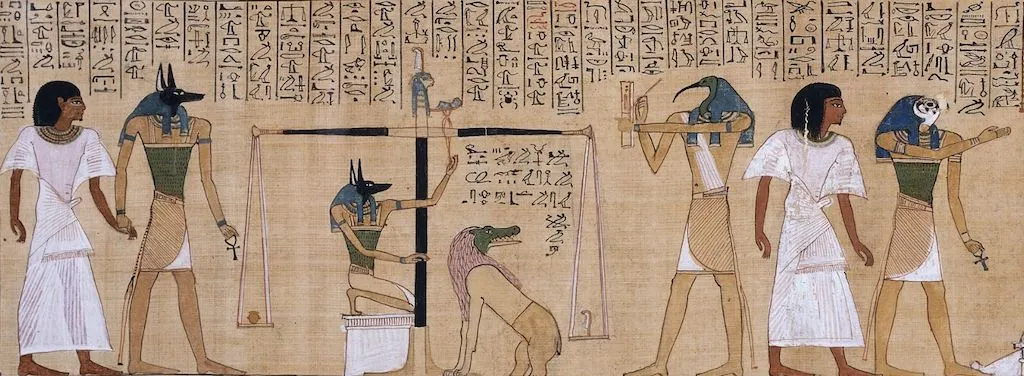
There, Osiris and a jury of forty-two assessors would place the heart of the deceased on a set of scales. On one side of the scales, the person's heart. On the other, a single feather.
But this was no ordinary feather; it was a feather of Ma'at, the goddess of truth and justice². Ma'at is the daughter of Ra and is often depicted with an ostrich feather on her head, the same feather in the weighing ceremony.
The Heart and Soul Connection
The Egyptians considered the heart as the seat of the soul, the center of morality and consciousness. Similar heart-soul connections exist in the Jewish tradition, too.
If a heart was as light as the feather, they were judged righteous. And the righteous would proceed onward to eternal life.
On the other hand, if a heart was heavy, weighed down by cruelty, greed, and injustice, a less pleasant fate awaited. A sinful heart was fed to Ammit, a lion-hippo-crocodile kind of beast, followed by a sort of "second death."
Though we may get a different impression in Exodus, scholars suggest that many Egyptians lived their lives with this end in mind. In other words, this was not a fringe idea in Egyptian society, relegated to religious elites.
The Irony of Truth
One of Pharaoh's core religious responsibilities was to uphold order and justice. He was to be the earthly embodiment of truth.
It seems ironic that Pharaoh was supposed to be the guardian of Ma'at. In Exodus, when his heart failed the judgment, it signaled a significant disconnect of his identity and divine authority.
Pharaoh's Heavy Heart
As stated above, the Torah use 3 words to describe the hardening of Pharaoh's heart. The Torah is telling us that Pharaoh's heart was found to be heavy, kaved (כָּבֵד).
Those familiar with Egyptian lore would recognize the language of the scales. A heavy heart was a condemned heart.
If indeed this is the intent, the plagues reveal a deeper judgment of Pharaoh, one that came through the framework of the Egyptian heart-weighing ceremony.
The Plagues as Divine Examination
One major shift, though, is that this judgment was not happening in the afterlife, on Egyptian terms, but in real time by the G_D of Israel.
As we've covered before³, each of the plagues served as a direct attack on a particular Egyptian deity. With each weighing of Pharaoh's heart, another god was punished and cast down for all of Egypt to see.
It makes sense. If you want to send a strong message, you use a system the people would have been familiar with.
It would then make sense of G_D to use their native belief system for this show of force. In fact, He says this was His goal:
The Egyptians, too, will recognize that I am G_D...
- Exodus 7:5
Therefore, the Creator was not merely tampering with free will for the fun of it. Instead, the plagues represent a systematic dismantling of the religious framework that gave Pharaoh his authority and identity. And this process played out to the very end.
By the time the plague of darkness falls and the firstborn are found dead, Pharaoh has been through his own version of the Hall of Two Truths. This display of power compelled many Egyptians to follow the Israelites out of Egypt.
I encourage you to listen to Rabbi Sacks' teaching or even pick up one his books⁴, as there is more to explore in this connection.
Borrowed Cultural Influences
At first, it might seem strange that the Bible would co-opt ancient belief systems of Egypt and other neighboring countries., but these traces can be found all throughout the texts.
Some posit these as evidence of syncretism, but I believe it illustrates how the Creator will often speak to people through their flawed beliefs and the errant theologies of which the are accustomed to.
And, this is not a unique case, there are more of which we'll explore together.
Want to Learn More?
 The Hidden Orchard
 The Hidden Orchard
 The Hidden Orchard
Notes
¹ The Weighing of the Heart. Rabbi Jonathan Sacks, z''l