
Traditions and Commandments: Understanding Jesus's Teaching in Mark 7
Did Jesus reject Jewish dietary laws, declaring all foods clean? In this article, we unpack the discussion in Mark 7 to challenge the popular tradition that Jesus abolished Torah-given commandments, and reflect a misreading of first-century Judaism.

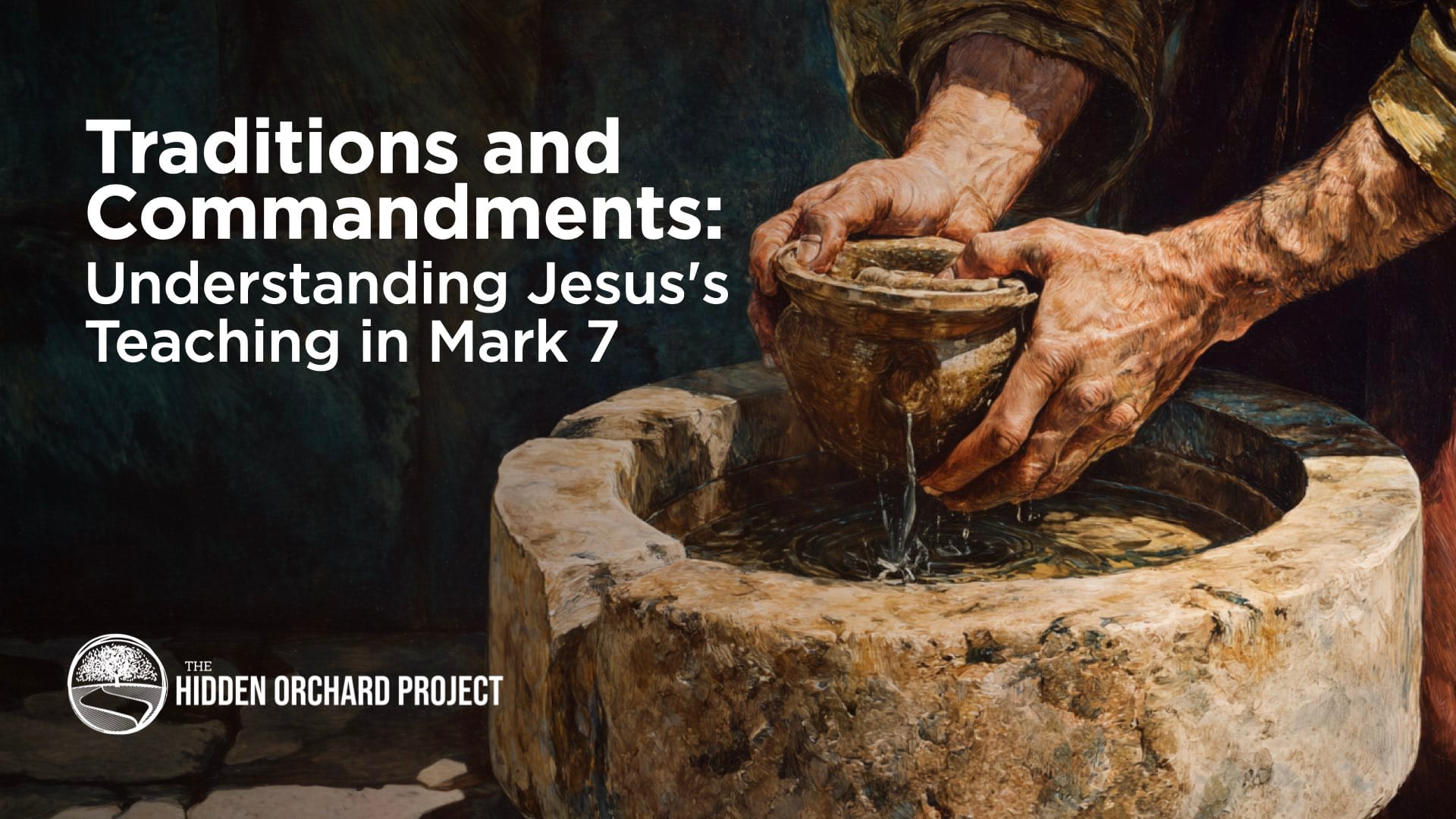
Few passages in the New Testament have been as misunderstood as Jesus’s teaching in Mark 7.
The popular interpretation leaves readers convinced that Jesus swept aside the Biblical dietary laws with a single sentence, and with them, Judaism itself.
This assumption has aided the development of Replacement Theology and deepened the divide between Christianity and its Jewish origins.
But what if this popular reading is a misinterpretation?
The Lost Context
To understand what is happening in Mark 7, we first need to step back into the Jewish world of the first century, a world that no longer exists.
The New Testament is a freeze frame of a time before the codification of Jewish law. The Apostolic writings preserve early legal debates that were resolved after the destruction of the Temple.
Modern readers, unaware of this history, mistake them as a portrayal of Judaism as a whole.
Two Torahs
During Jesus’s time, many areas of Jewish law were still unsettled. The Bible left a lot of room for disagreement, and well-intentioned debates often became heated.
The arguments captured in the Gospels often trace back to these early disputes, particularly those between the two major Pharisaic schools of Hillel and Shammai.
Their differing approaches created real tension in day-to-day observance. As the Talmud states, for the average person trying to remain observant, it was as if there were “two Torahs” (Sanhedrin 88b).
In this context, it was easy for teachers to lose sight of the big picture. They were not only expected not only to explain the proper practices, but remember the fundamentals of spiritual life.
For instance, while handwashing is of value, there are other openings for impurity to be aware of. This will become central to Jesus’s rebuke and overall lesson in Mark 7.
Types of Impurity
First-century Israel lived under Roman rule, a powerful pagan nation. This created daily challenges, such as; buying food, entering homes, stepping into markets, and interacting with non-Jews. These all posed real risks of acquiring impurity.
Acquiring tumah inadvertently was not sinful, but failing to address it was. Impurity could bring sickness, distance from G_D, and more sin. Most importantly, impurity drives away the Divine Presence.
But the Rabbis recognized two forms of impurity: physical and spiritual. The Midrash⁶ provides a list of dangerous spiritual impurities:
- Blaspheming
- Immorality
- Bloodshed
- Bearing false witness
- Haughtiness
- Entering a stranger’s house
- Lashon Hara
- Lying
- Taking a false oath
- Idolatry
- and more.
This list seems strikingly close to Jesus's list in Mark 7.
Hand-Washing (Netilat Yadayim)
In the generation before Jesus, the Sages determined that ritual hand-washing, originally a priestly practice, would benefit all Israelites. Their reasoning had biblical foundations, but Scripture provided no specifics.
As a result, the schools of Hillel and Shammai developed different customs. (We explore these differences in detail here⁴.) But Jesus was not arguing against washing hands. He sidestepped the halachic dispute entirely.
To me, the washing of hands was really a device to bring forth a spiritual lesson of ethics and the less-scrutinized means of acquiring impurity⁵.
Thus, “All Foods Are Clean”
With the context in place, the popular reading becomes less convincing.
The claim that Jesus nullified the dietary commandments depends almost entirely on a single parenthetical line:
“This means all foods are clean.” — Mark 7:19b
Some problems.
1. The parenthetical statements are not original
Parenthetical statements are often not found in early manuscripts. Scholars often associated these with later additions, scribal notes or commentary by later audiences. They are subject to error and often reflect an interpretive bias.
2. The logic does not hold
If Jesus rebukes the Pharisees for overturning G_D’s commandments in favor of their traditions, it would be illogical to argue that he immediately proceeds to do the same by dismissing the biblical dietary laws!
3. Jesus warned against abrogating Torah commands
Perhaps the biggest flaw in logic is that Jesus famously warned his disciples against abandoning even the smallest of commandments⁷. Overturning one of the most important categories in Torah, the dietary laws, would be a glaring contradiction.
4. His opponents never accuse him of this
If Jesus had abolished kashrut, it would have been a major violation of the Torah.
But Mark later records that they could find no such charges against him (Mark 14:55). This would have been a closed case had they understood his words in this way.
So What Is Going On?
The dispute in Mark 7 is not about kosher food.
It is about purity, and specifically the difference between external ritual and internal spiritual purity.
Jesus is not abolishing a commandment; he is addressing matters of the heart, aligning with the very concerns listed by the Sages.
The lesson: separation between a person and the Creator can be caused by physical means, but, most often, from what flows from a person's heart, and innerspace.
Notes:
¹ From Ruin to Resilience - Jewish Revival Post-Temple Destruction
² The Missing Context of the New Testament Part 1
The Missing Context of the New Testament Part 2
⁴ The Pharisees Who Wash the Outside of Cups
⁶ Midrash Numbers Rabbah 7:5