
Jesus Within Rabbinic Debate: Understanding the Gospel Conflicts
Though traditionally perceived as a break from Jewish tradition, Jesus’s arguments with certain Pharisees were well within Rabbinic legal norms. This article explores the Jewish legal and practical frameworks behind Gospel debates and how misunderstandings have shaped centuries of Christian reading.

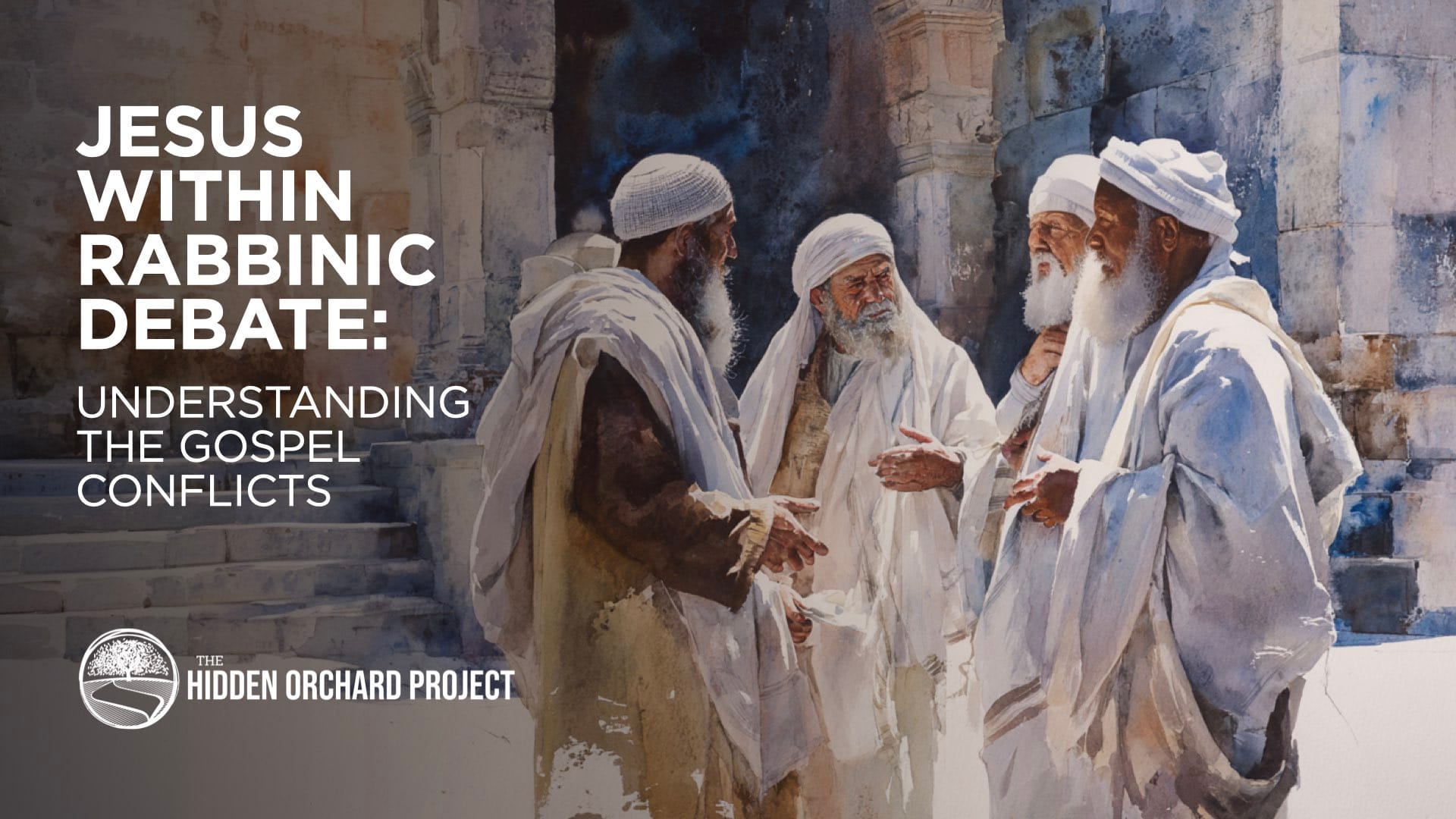
For centuries, the disagreements between Jesus and the leaders of his day have been read as an intense and deliberate break from all things Jewish. This perception contributes to an ongoing anti-Rabbinic bias in the Christian world and much of Messianic Judaism.
When Jesus's teachings are read through this bias, his intended message is often lost in an anachronistic and false dichotomy of Christianity vs Judaism.
But what if these exchanges are not unique in the Rabbinic disputation of the first century? What if these arguments are grounded within a framework?
In this article, we will walk through a few of the most common examples, adding clarity and a lesser-known structure to arguments.
Arguments for the Sake of Heaven
The word for argument in Hebrew is makhloket¹. A makhloket was not a failure of the system; it was, and is, a core feature.
A makhloket is not about winning an ego-fueled debate, but about finding the proper application of a Torah commandment. Often, both sides of these arguments are viewed as valid, "for the sake of Heaven" (Pirke Avot 5:17). If you are a student of the Talmud, you might be familiar with this kind of discourse.
I hope to show that Jesus's arguments were not rants and fit within the range of a few Rabbinic legal principles. These terms will be new to some, but familiarity with them will unlock understanding.
1. "Gezerot" | Rabbinic Fences
Since ancient times, leaders have been instructed to:
“...make a fence around the Torah” - Pirke Avot 1:1
In Jewish law, a Gezerah (גזירה) is a decree that enacts a protective measure intended to prevent inadvertent violations of a Torah commandment.
These decrees are not arbitrary. They are the result of second and third-order thinking processes where the Rabbis consider and plan for foreseeable risks.
Many of the classical debates between the schools of Hillel and Shammai revolve around Gezorot, and where exactly to draw the line.
Also, Gezorot (plural) are often conditional. This is especially true when they undermine the Torah commandments, burden the community excessively, or become detached from the ethical aspect.
When this happens, decrees are subject to critique or reversal. The Talmud states:
“One does not issue a decree upon the community unless the majority of the community is able to abide by it.”
- Avodah Zarah 36a; see also Bava Batra 60b
Far from being anti-Rabbinic or anti-Torah, pointing out flaws in Gezorot is a critical feature of the Jewish legal process.
Jesus's Critique of Gezerot
To me, it seems most of Jesus’s conflicts align with this category. For example, during the hand-washing dispute in Mark 7², Jesus said:
“You leave the commandment of G_D and hold to the tradition of men” - Mark 7:8
In context, the tradition Jesus is speaking about is presumably faulty Gezorot. His argument is not a rejection of decrees or tradition in general, but a normative halachic critique of a Gezerah that has become misaligned with the purpose of the commandment.
In this exchange, the emphasis on physical purity, likely associated with the approach of the school of Shammai, seems to have neglected the focus on spiritual purity.
2. "Taʿam Mitzvah" - The Reason
Another common occurrence is when Jesus teaches a new spiritual insight juxtaposed to a known Torah commandment.
In Jewish discourse, this shift is called Ta'am Mitzvah, a "taste" of or the reason for the mitzvah. Over time, spiritual practice can degrade to rote obedience. When this happens, it is easy to forget the point of the mitzvah.
But many have mistaken his critiques as a call for an abandonment of the commandments altogether. This reading and the steady creep of later philosophical influences³ has contributed to a de-prioritization of the commandments.
However, the Sermon on the Mount⁴ is best understood through the lens of Ta'am mitzvah reasoning. Nearly all of Jesus's teachings in the Sermon on the Mount find a parallel in the Talmud showing accordance with many Rabbis of his generation.
These meditations on the inner purpose of everyday commandments are intended to strengthen and encourages observance. Jesus's teachings here mirrors Rabbinic Mussar⁵ instruction. This is not the language of legal discourse.
3. Messianic Foreshadowing
In some cases, Jesus's arguments are framed as a kind of Remez or Midrash. The entire discussion only makes sense if the audience is living within a Torah lifestyle.
This is the core idea in many of the healings on Shabbat. In the first century, most categories of healing were already permitted by the Rabbis. If a life was in danger on Shabbat, it became a mitzvah to violate the Shabbat and preserve life.
The Gospel's depiction of Jesus's miraculous healings traverse into territory not litigated in Jewish law. These accounts leverage Prophetic themes, foreshadowing Messianic expectations when the blind are made to see, the lame are made to walk.
To me, it seems the argument was a pretext to a sign of messianic portent.
This can be explored in more depth, here⁶.
4. Pedagogical
With this last point, it is important to remember that the Apostolic writings were written to an original audience.
Unlike the Rabbinic legal literature that incorporates both positions of an argument behind the ruling, the Gospel disputes are asymmetrical. They mostly lack the other side of the argument.
Instead, the Gospel stories function as a pedagogical device to teach moral lessons to readers. They are built upon existing Torah practices and point to ethical teachings that can be passed down.
Reading them as literal halachic debates leads to massive misunderstandings, as does reading them to the conclusion that Jesus abolished the Torah⁷ and tradition⁸.
(Stay tuned as we will explore this in more depth soon.)

Notes:
¹ https://voices.sefaria.org/sheets/192159?lang=bi
² Traditions and Commandments: Understanding Jesus's Teaching in Mark 7
³ The Accidental Apostle: The Story of Pseudo-Dionysius
⁵ Mussar
⁶ Unraveling the Controversy of Healing on Shabbat in the Gospels