
The Woman At the Well. John's Midrash on Ezekiel and 2 Kings
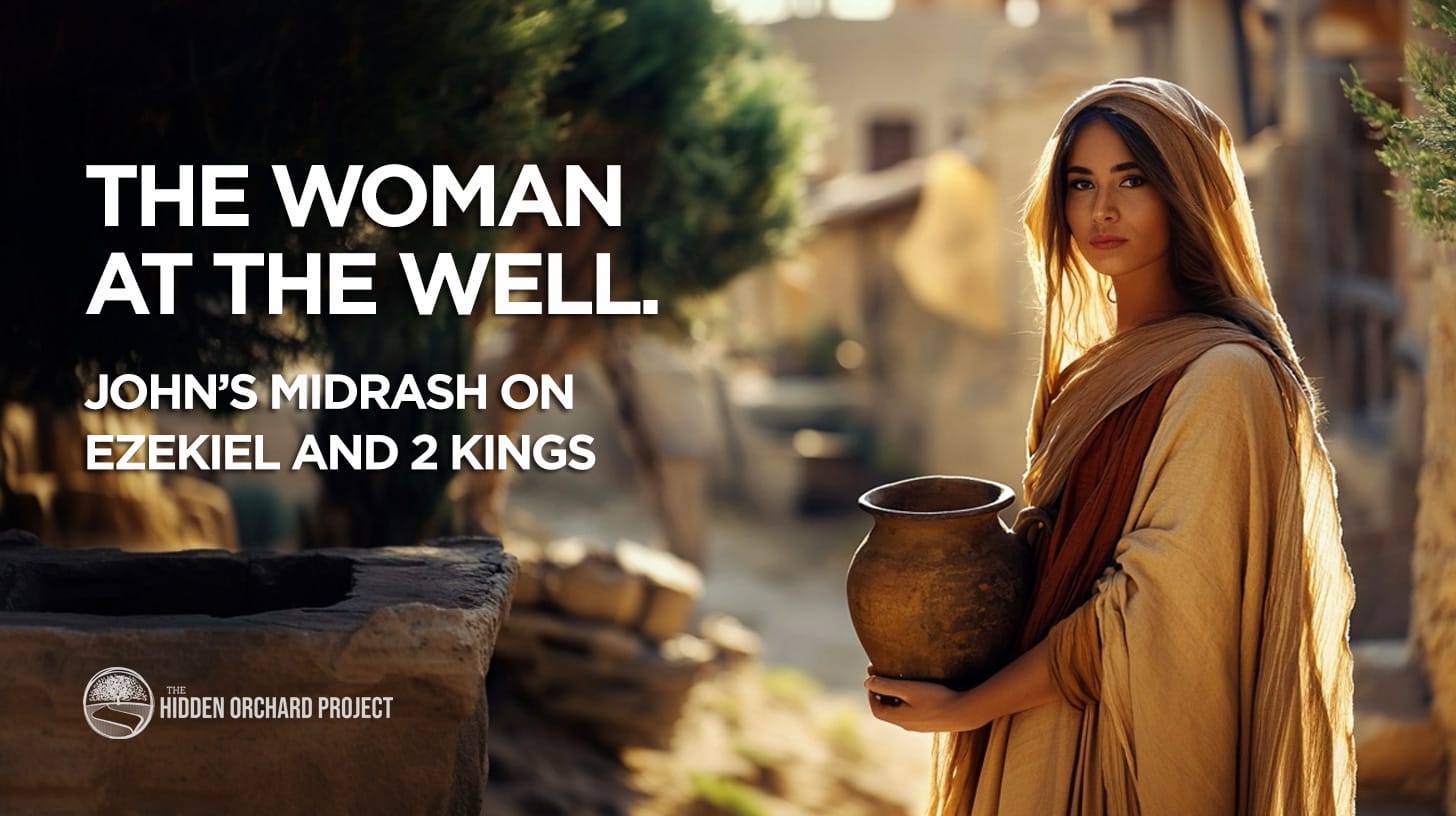
In this article, we explore John 4 through the lens of Rabbinic Midrash and its links to Ezekiel 16 and 2 Kings 17. Is the Samaritan woman a creative representation of Ezekiel's prophetic narrative, and if so, how does this change the way we read the Gospels.
When we read the New Testament as a product of first-century Jewish, particularly Rabbinic thought, a genre shift occurs, overlaying a different set of literary rules and expectations.
Storytelling Vs Historical Accounting
One of these shifts is that Rabbinic literature is less concerned with historical accounting and tends to focus on spiritual themes and moral lessons. It is not uncommon for a story to be retold with a different cast of characters and slightly different details.
In this way, a story can be tailored to impart a moral lesson for a later audience, all the while still anchored in the Biblical texts. In this way, a good Midrash can bring a scriptural passage to life in a memorable way.
Midrash in the New Testament
If the Gospels are indeed drawn from this well of tradition, we should expect similar creative liberties within their pages.
We've explored this through the Gospel story of the Healing of the Woman and the Girl¹ and many others. Through these, what seems to be an account of healing creatively dramatizes the final redemption of Israel from the nations.
A Working Theory
In this article, we'll explore another one: the story of Jesus and the Woman at the Well. My theory is that this story is a Midrash; a tale of redemption based on Ezekiel 16 and 2 Kings.
The encounter with the woman at the well is only found in the Gospel of John. This is significant as John's writings are cryptic at times, layering themes of Messianic redemption with a flourish of Mystical and Rabbinic tradition.
Jesus's encounter with the Samaritan woman contains similar elements, which we'll explore.
But let's first re-establish who the Samaritans were, and why this would carry any meaning with John's audience.
Samaritans
Samaritans and Israelites had a complex relationship, to say the least. Samaria was home to people who traced their lineage to the tribes of Ephraim, Manasseh, and remnants of the northern kingdom.
While they shared common ancestry with the Judeans, centuries of theological divergence and rival claims of legitimacy - especially over the proper sanctuary, Mount Gerizim versus Jerusalem - grew into mutual hostility.
However, many outside and contemporary writers found no discernible difference between Jews and Samaritans². In the Talmud, this shared lineage seems to have resulted in the Samaritans holding a somewhat unique halachic status at times, somewhere between Jews and Gentiles.
On the other hand, the Samaritans were a mixed people, due to the Assyrian practice of sifting various nations throughout their empire. This will factor into our exploration shortly.
By the first century, Samaria may have contained a number of remnants of the northern tribes of Israel who had become assimilated into the local cultic worship and practices.
In short, both groups:
- Traced their origins to Abraham, Isaac, and Jacob.
- Had a version of the Torah.
- Believed they were the true covenant people of the G_D of Israel.
A major point of contention between the Samaritans and Israelites was around the [Pharisaic] Oral Torah³. Like the Sadducees, the Samaritans rejected the Pharisees' views. The Apostolic community generally upheld the Pharisaic traditions and tenets (ie: the belief in a Messiah, the resurrection, Olam Haba, etc).
Nevertheless, for Jesus, the redemption of Samaria may have been an important prophetic fulfillment of his mission to return the 'lost sheep of Israel.'
The Woman
But in order for my theory to hold any water, we would have to establish that the woman in the story represents Samaria on the Midrashic level. The Bible (and Rabbinic literature) often refers to nations and people groups in the feminine.
We find a connection in Ezekiel 16:46, where Samaria is called a "sister." Ezekiel compares Israel to Samaria as women who have engaged in various illicit sexual behaviors and have generally behaved badly.
The Water and The Well
The scene at the well creatively reflects earlier water-well tropes in the Torah:
- Abraham's servant and Rebekah (Genesis 24:10–27)
- Jacob and Rachel (Genesis 29:1–14)
- Moses and Tzipporah (Exodus 2:15–22)
In the Rabbinic tradition, water⁴, and by extension, wells, serve as a powerful metaphor for Torah knowledge and revelation.
Jesus's offer of "living water" is a deeper reference to true knowledge of G_D and a taste of the redemption to come. The Midrash says:
Just as water is a source of life for the world, a garden spring, a well of living waters, so is the Torah a source of life for the world... - Song of Songs Rabbah 1:19
This would be particularly important for the Samaritans, who were lost in a false religious system.
Double Speak
The conversation between Jesus and the woman seems to get off to a rough start. Jesus speaks on the spiritual level, but she seems stuck on the physical level. This is common in John's Gospel. We see the same dichotomy when Jesus converses with Nicodemus⁵ and others.
This disconnect, though at the woman's expense, is a hat tip to the readers who are clued into the hidden meaning in Jesus's words. And so we wait a few verses for her to catch up.
Five Husbands - 2 Kings
At one point, Jesus calls for the woman to get her husband. After the woman admits that she has none, Jesus reminds her of her five other husbands.
As many are aware, the word for Husband, Baal (בַּֽעַל), can also serve as the word for Master, or a common name for a false god.
As to the five husbands, our clue comes from 2 Kings 17:24 where the text mentions five nations that the Assyrians blended into Samaria.
Each of these nations had its own false gods, of whom the Samaritans began to worship. They are: Babylon, Cuthah, Avva, Hamath, and Sepharvaim. The text even goes on to name these five false gods⁶.
The Samaritan Problem
The text of 2 Kings fills in the gaps from Ezekiel 16 spells out the primary problems with the Samaritan people:
They do not worship G_D [properly]. They do not follow the laws and practices, the Teaching and Instructions that G_D enjoined upon the descendants of Jacob—who was given the name Israel... - 2 Kings 17:34
The problem seems to be their errant theology, all of which John captures in his telling.
- The mention of Jacob (John 4:5-6;12)
- Not following the laws and practices, teachings, and instructions (ibid 22)
- Salvation is from the Jews - (ibid 22)
Salvation is From the Jews
John's mention of the "teachings, practices, and instructions" is an endorsement of the Rabbinic oral tradition. This is another stunning endorsement for the Rabbis from Jesus.
As in other places, we can understand this to mean more than simply worshiping at the Temple in Jerusalem, but also the traditions, the teachings, and the interpretations, "for they sit on the seat of Moses.⁷"
Incidentally, Jesus missed his chance to embolden the Replacement theology⁸ claim of many that he left Judaism behind. Instead, he states:
You worship what you do not know; we worship what we know, for salvation is from the Jews.
- John 4:22
Conclusion
There is certainly more to unpack in this chapter, as John has laid several hints worth exploring. Ezekiel 16 also goes into the theme of food, a topic mentioned by Jesus in John's telling.
If this story is indeed a Midrash built from Ezekiel and 2 Kings, it reflects a distinctly Rabbinic method of interpretation. The result is a memorable narrative of hope.
These were the very storytelling techniques that shaped the world in which Jesus and his disciples grew up.
And why does it matter to a first-century Jewish audience? Ezekiel tells us:
I will restore their fortunes—the fortunes of Sodom and her daughters and the fortunes of Samaria and her daughters—and your fortunes along with theirs.
- Ezekiel 16:53
The redemption of the people of Sodom and Samaria signals the redemption of Israel, when all things are restored.
Want to Learn More?
 The Hidden Orchard
 The Hidden Orchard
 The Hidden Orchard
Notes:
¹ The Healing of the Woman and the Young Girl
² Jew & Gentile in the Ancient World. Feldman. Page 45
⁴ “Just as water gives life to the world, so does Torah.”- Midrash Rabbah Song of Songs 1:19
⁵ Spotlight: Nicodemus. Nakdimon ben Gurion.
⁶ 2 Kings 17:30-33
🌱 Enjoying what you’re discovering? 🌱
Support The Hidden Orchard and help us grow and share with others.